
Here is the english version of my now famous “Fallait demander” ; now available as a book with other stories :

Orders available here or here or here ^_^
Thanks Una from unadtranslation.com for the translation 🙂
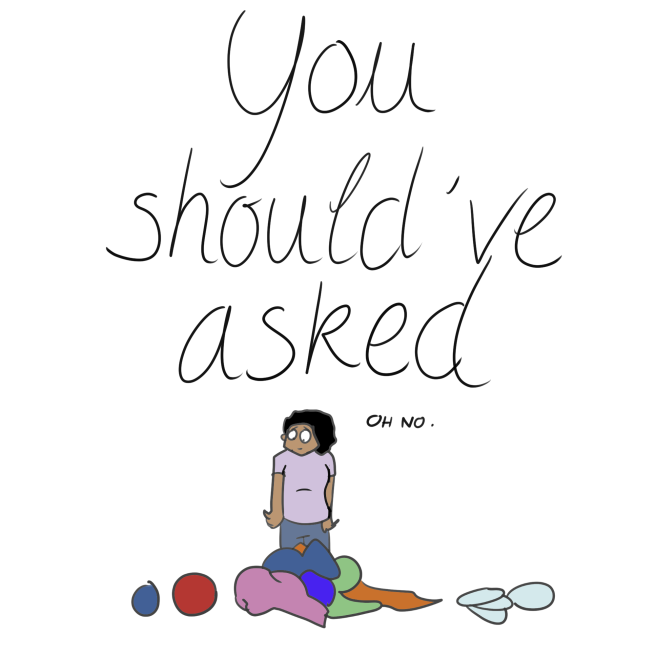








Here is the english version of my now famous “Fallait demander” ; now available as a book with other stories :
Orders available here or here or here ^_^
Thanks Una from unadtranslation.com for the translation 🙂
 Emma
Emma 
A similar document on “Emotional Labor” (long):
“I often talk about emotional labor as being the work of caring. And it’s not just being caring, it’s that thing where someone says “I’ll clean if you just tell me what to clean!” because they don’t want to do the mental work of figuring it out. Caring about all the moving parts required to feed the occupants at dinnertime, caring about social management. Caring about noticing that something has changed – like, it’s not there anymore, or it’s on fire, or it’s broken. It’s a substantial amount of overhead, having to care about everything. It ought to be a shared burden, but half the planet is socialized to trick other people into doing more of the work.”
http://drive.google.com/file/d/0B0UUYL6kaNeBTDBRbkJkeUtabEk/view
LikeLiked by 7 people
Thank you. This is great. I often go around in circles at home putting things away just like that, sometimes for hours.
LikeLiked by 4 people
Emma, I have thought this or along similar lines a few times with my husband. I have hesitated about going back to work because I feel like how will I do it all (OK,90%) plus work? Also, I noticed a small mistake in the translation in the line where the couple is watching TV, born should be borne with an E.
LikeLiked by 3 people
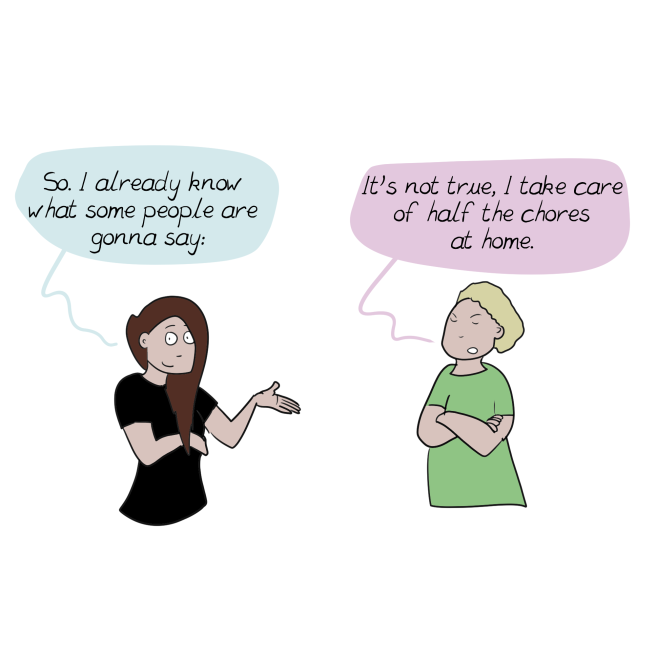
This article is biased as it doesn’t mention when the man has a full time job and the woman looks after the household. Of course she does more around the house as the man works his arse off to pay for it all. If things were equal and both parties worked as much as the other, then yes, duties should be equal as well. However, if you don’t take into considerations outside the household then it makes you look narrow-minded and makes us think you have no grasp of the bigger picture. Just typing words that fit your own narrative.
LikeLiked by 4 people
Thanks for mansplaining it. I forgot that household and child rearing duties stop the minute that clock hits 5pm 🙄
LikeLiked by 2 people
True. Agree 100%. Husbands work in the household too.
LikeLiked by 2 people
As a new mum I have to say that I am on duty 24 hours a day… interrupted sleep all night, checking the baby´s temperature, that he’s comfortable, and safe. Then all day long caring for him and keeping the house organised. I have very little time to myself, even when I have a minute, Im listening for him because he’s taking a nap and may wake up and need me at any second. I have to look after my partner too, to make sure he does what he needs to do to keep things running. John, I feel like maybe you haven’t really understood the article. Try again.
LikeLiked by 2 people
Throughout this whole comic, it talked about woman returning to work after having children and needing to manage work life with raising children and managing a household. In my personal relationship, I managed the household with little to no input from the male housemates (which included my partner) while working a full time job and excessive over time. It was expected by the males that I would be the one who organised rental payments, grocery shopping, cleaning, maintenance and gardening. It was unspoken but implied many times that it was my position as the only female in the house to take on this role. Once I had given birth, it seemed even more so since I had begun child rearing. I don’t appreciate these stereotypical ‘traditional roles and become rather frustrated when I see gender biased ideals being passed onto my children. I currently work part time, study full time, manage the household and am the primary carer for my children while my husbands role hasn’t changed since before we were married and he hasn’t taken on more responsibility since I went back to work or took up education.
LikeLiked by 2 people
Sorry i have ZERO empathy. Know why? I’ve worked full time WITH and WITHOUT children and I still did the majority. For a while I just took on the load. Commuted to work 3 hours, put in a further 8.5 hours and then came home – maybe stopped at the shops first – got the dinner ready, cleaned up, did the reading and homework, gave the bath. He “helped” by putting the dishes in the sink and just hovering around when I started huffing with frustration.
I’ll tell you this though. He was absolutely devoted to screen time (he needed to relax and download movies for the family apparently). And he was more than capable of organising events for his social and Instagram groups.
So I divorced him. And my workload is sooo much lighter. I feel free and unshackled. And now he has the children half the week. He’s doing more so to speak, he has to. But I’m still carrying the mental load and managing him. It’s inescapable. Frankly it has turned me off any sort of live in relationship or marriage and I go cold when a young female friend or relative announces she’s getting married. Unfortunately nearly every married/divorced woman I know gets where I’m coming from.
Like most men my ex still says “if you need help, ask”. He has no idea why I find that concept offensive. Firstly I don’t appreciate being put into position of project manager of another adult/partner nor do I want to nag. Nor do I want my brain to be filled with tasks and delegations.
This is why women are losing so much respect for men. Even if they do work full time it’s no excuse for them to drop the ball of adult responsibilities. It’s hard to find any man sexually attractive when he positions himself as another one of your children.
LikeLiked by 3 people
Problem is that – as the comic notes – when the woman does work full time, it (often) doesn’t change. He might do the physical stuff (when asked to) but not recognise when it needs to be done.
LikeLiked by 2 people
You are missing a major point about mental labor. You as a man should want to know what, how and when to feed your child. You should know and want to pick up after yourself. You should understand when and how to address sanitary issues (cleaning the bathroom, refrigerator, not leaving clothes in the washer.) And maybe you already do. But this article is not just about the division of labor stay at home moms. This is about mental labor. An invisible factor that addresses the management of the household. Please read this again with an open mind.
Best,
LikeLiked by 2 people
The studies on this have shown it makes no difference whether the woman works outside the home or not – and most do, by the way. So you can probably google those and grasp the bigger picture yourself, though that wouldn’t fit your narrative, I suppose.
LikeLiked by 2 people
Are you freaking kidding me?!
Poor little butthurt snowflake little boy doesn’t want his ignorant, lazy bubble burst. Keep dropping your towels on the floor, lad, and pat yourself on the back as a hero for ever lifting a finger. I’m sure you’re a gem and the women can’t get enough of you.
And as far as how posts make people look–your post makes you look like a self-important wanker.
LikeLiked by 2 people
If the woman’s job is to run the household then that’s her job. But when both parents work outside the home, somehow it’s STILL the woman’s job, also and on top of her paid work, to run the household.
You can write so blithely that duties should be equal, and completely miss the point that they. are. not. equal.
The male parent does not invest his precious free time in emotional labor. You seemed to have missed several panels that pointed out since the woman did all the childcare physically as well as emotionally,w hen she goes back to work she is expected to ASK FOR HELP — as if the male parent has no appreciation for the work being done and no concept that hey, I have to share in that now since she’s sharing in the working for pay. Nope, it’s ask and ask and ask and ask for yet another thing. No where in there is the wife asked what all she’s doing and how he can do his share.
LikeLiked by 2 people
hey mate, I’m not wanting to start a troll session or anything so please take my words in a calm non offensive manner. Your paragraph above seems to demonstrate that you have really missed the point of the comic and the issues and circumstances in which it occurs. Also you seem to underestimate the prevalence of the problem and its effects on most women. I know that it’s not all men, I know that its not all situations, but please have a deeper look at the comic and the problem that it articulates. Rather than being defensive, please try to imagine the situations where this does apply and try to think of ways that you personally can address those situations. I bet that you’ll be able to find some if you think about it. Don’t worry that not all situations are like this but help us to address those that do. I’ve still got a long way to go myself but I’m having those discussions with my partner and hopefully her life is better for it. I know that mine is.
LikeLiked by 1 person
No. Most women nowadays work outside the home, working their “arses” off, just like men. Then they come home to do the 2nd shift of childcare and housework. This article was spot on.
LikeLiked by 1 person
She pretty clearly describes a situation in which both partners are working jobs. In the first panel she wrote “a colleague”, later she references women in the workforce, then mentions “once we’re back at work”. You are clearly just reading what you want to fit your own narrative.
LikeLiked by 1 person
Boy, that didn’t take long.
LikeLiked by 1 person
Boy, that didn’t take long.
LikeLiked by 1 person
I think you’re missing the point of the comic. The point is that a substantial amount of the mental and emotional work is left to women, whether they work outside the home or not. This gives women the feeling that they are managing the household because they have to keep everything and everyone organized and on track. As a mother of a special needs child who also works a full time job while my husband goes to school and works part time, I see this in my own household. My husband will gladly help with whatever I need him to…but I still plan for it, schedule it, and make sure he has everything he needs to get the job done whether it’s washing the dishes or taking the baby to a doctor’s appointment.
LikeLiked by 1 person
If you want to talk about bias – you’re stating that this article isn’t valid because it doesn’t discuss the MINORITY of family dynamic scenarios where women stay at home.
In 1999, 23% of women were stay at home mom’s. Surprisingly, that # has risen, but it’s still only 29% as of 2014.
Meaning the vast majority, 71% of mothers, work. So maybe be a little less narrow minded, and look at the majority of women this applies to, and stop typing words to fit your own narrative.
LikeLiked by 2 people
Most women I know work full time, sometimes more than one job and does 100% of running the household. If a man wants to be the breadwinner and let me stay home, then by all means I’ll do ALL the work at home with a smile. But while I work full time and pay the majority of the bills don’t throw that crap in my face that the man can’t help around the house because he “works too hard”.
LikeLiked by 2 people
You’re forgetting about the women who also handle the household on top of the full time job. The fact that you’re disputing this raises some red flags.
LikeLiked by 2 people
Stay-at-home moms do exist in great numbers, but they’re in the minority. This comic is specifically about couples who both work, which is the default in America and much of Europe, though they have much better maternity leave.
Studies have shown that all the work “stay at home moms” do – cooking, housekeeping, finances, child care – would be worth upward of $140k if outsourced to professionals. Unless the man is making at least that, is it really equitable?
LikeLiked by 2 people
Both parties DO work as hard as the other. Your comment is an example of what the comic is trying to address: “full time” career work is just as valuable as the mental, emotional, and domestic labor done by women in the house. Just because domestic labor isn’t pay does not mean women do not work as hard as their husbands.
LikeLiked by 1 person
Ok, so what about even the woman goes back to work and still does everything at home?
This isn’t attacking men. This isn’t blaming men for anything. It’s just presenting fact.
You’ve missed the point entirely.
LikeLiked by 1 person
Bull. My husband and I BOTH work full time. Most of the couples I know work equal hours outside the house. It’s no longer true that women always stay home, caring for the house and children, while the men go to work. You seem to be the one with no grasp of the bigger picture.
LikeLiked by 1 person
I’m not saying I necessarily agree with all things in this article, but this article appears to be mainly referring to wives who DO work full time jobs outside the home “and works their arse off to pay for it too” (while managing the home).
LikeLiked by 1 person
I’m in a situation similar to this…I do work, but I’m self employed as an artisan and spend most of my time at home with our kids. I feel comfortable taking on much of the household-side of work, because I AM home, but I will say this…when you add kids into the mix, it does require both parents to shoulder some of the load. I would never ask my husband to take our six year old and five month old to work with him – he’d never get anything done! By that same token, it’s difficult to clean, cook, do shopping or laundry, take care of home improvements or repairs (yes, I do those not him) when trying to tend to a young child and infant. I wouldn’t say that our home loads are equal, but my husband wouldn’t dream of expecting me to cook dinner WHILE feeding our baby, or for me to do ALL the laundry, etc etc….if he sees something that needs doing, he does it. “Home management” is a job, and parenting is a whole separate job. When you become parents, you both work double shifts.
LikeLike
The overwhelming majority of households are two income households these days, meaning both the father and mother work. There are even households where the dads are the ones that stay home, because mom has a higher earning potential. Not mentioning that some women stay at home and are thus expected to do more of the work does not negate that the overall trend the article discusses, which is that nearly all women are expected to do the majority of the household chores, regardless of whether or not they work during the day as well.
In my parent’s house, my mom works 40 hours a week and comes home to my dad who is unemployed (he says he “retired early” but really he doesn’t feel like looking for work and knows that once she retires her retirement plan will be able to take care of them both). She still cooks dinner almost every night. She still spends her evenings and weekends doing laundry, vacuuming, planting the garden, weeding, dusting, etc. He spends his days reading articles on the internet and watching TV shows he doesn’t think my mom will like. I guarantee there’s a more than 2.5 hour a week difference in the amount of household chores they do. And SHE’S the one that works.
LikeLike
Did you miss the part about how all of thr women in the stories, were working mothers? Besides one does not negate the other, you should always help your spouse, even if it’s just takinf the trash put without them asking.
LikeLike
So just because you’re out of the house working, your wife isn’t working 24/7 at home with no pay??! Give me a break. Things need to be equal in a relationship. No one partner works harder than the other in a family. There needs to be compromise and consideration.
LikeLike
I do believe that’s exactly what she is talking about, did you read until the end? Women staying home is becoming a thing of the past, at least in the US, because couples can’t afford to have a partner stay home, but the chores still stick to women.
LikeLike
Except that a job is 38 to 40 hours a week and running a household is 24 x 7. This is the attitude that is wrong. Even if a woman does not have a job, her job isn’t 9 to 5 with weekends and evenings to do as she pleases now is it? I know I personally go to work to get a break!
In my household I also work, I earn the most money (even though I work the fewer hours) and yet I am still managing the entire household – the children, the budget, the food, the shopping, the cleaning, the social activities etc etc. My husband wouldn’t have a clue at half the stuff that goes into running our household. My husband states it is because I am “better” at it and yes he often says “just tell me what you want doing and I will do it” but that is the whole point – the thinking of what needs doing and the organisation required is exhausting in itself.
LikeLike
You are missing the bigger picture.
Attending to infants, toddlers, and young children is an arse load of work all in itself. If you ever stayed home and tried it out for a few months, or fully listened to women or men talk about it that do, you would know that child rearing is a full time job even without all the extra household work. There is no payment, and no cultural recognition for this work, which your comment illustrates beautifully. The man works his arse off to pay, you don’t value the round the clock work of child rearing, and therefore the woman should be grateful to take on the second job of managing all household affairs as well.
Household duties should be equal regardless of whether the mother/father stay at home to raise the children.
LikeLike
This narrative you suggest above means that you did not understand the comic above. I would suggest you re read, as whether your partner does or does not work outside the home, caregiving for human beings all day is a full-time job as well. And while they are responsible for caregiving, housekeeping, errands, are not included. Both partners work whether inside or outside the home and the tasks listed above should be split.
Stating that a man who’s spouse works should take on these but not one who’s wife stays home is why this world will continue to perpetuate these stereotypes.
If your spouse stays home and is responsible for the caregiving of your children I would bet money your wife would LOVE the extra help & support with the above!
LikeLike
Clearly, you missed the ENTIRE point of the post.
Do you need your binky, Jonathan?
LikeLike
You have just turned being a stay-at-home mom into a worthless but 24 hour-a-day job. Apparently there is no worth in that job because you are working your arse off to pay for it all. Do you pay her? WHO pays her? Is the care of your home and child carry a monetary value? Is YOUR job 24-7? If you were living alone, with a child, how much would you pay for someone to care for and raise your child, do your laundry, clean your house, prepare your meals and be on call all hours of the day? Not to mention do the shopping, plan the meals, plan and execute social events, clean toilets and bath, and put up with your sorry arse? Attitude like that, if you are married, you won’t stay so for long.
LikeLike
In your mentioned situation, does the woman have children at home to look after or is she just at home? Different scenarios create different outcomes. In a family with young children, the woman’s job is to raise the children and look after their daily needs yet it is also expected she do 100% of the housework while also making sure she raises strong, smart and capable individuals. Then at night time when the man who has been working hard all day comes home, he comes home to dinner made, kids clean ect and when he sits down to relax at night, the woman is preparing for the next day, tidying up after dinner, folding washing, budgeting, meal planning, booking appointments. Who really is working full time in this situation? The man who works 8 hours a day and comes home and helps with nothing or the woman who is running a household from the minute she wakes until she goes to bed. Maybe it is yourself who needs to grasp the bigger picture.
LikeLike
I think you missed the point. When the man in your above scenario gets home, he is “off work.” The woman in charge of the house never leaves work. She works 24/7. I’m a full time teacher and mom. Sometimes I’m even managing my home and family in my head from there.
LikeLike
I was also thinking this, that the narrative might be focused on a situation where both parents work. But, the drawings show a mom at home with the kids in a seemingly full time arrangement. I, also, am a full time stay at home mom. And there is quite a bit that rings true to me. While I do feel responsible for the mental organization of the household as it is my full time job, I believe the partner be fully engaged when at home. If I quit working when he got home then who will continue the work of the day until bedtime? When my husband comes home from work and it is dinner time and I am trying to cook a meal, rather than him seeing that the baby is crying and needs to be held or that the table needs to be set or a fight needs to be broken up between older siblings, he is focused on himself and his own desire to relax after being at work. I have to ask him to help out with everything. There is no awareness to what needs to be done and initiative to doing it. Yes, the spouse at work might be working that job, but there is another job waiting at home that needs to be done. For the spouse at home, that job is never done. It truly is a 24 hour job. I think much of this cartoon is focused on that problem.
LikeLike
Hm, that’s certainly a valid point. And it’s addressed in the part where you see a mother on her way home after work having collected her child, carrying the infant with her to shop at the supermarket on the way!
But that’s largely missing the point. Which is that while the physical tasks/chores involved in running a home and family are often shared these days, it is still usually a woman who assumes the responsibility for day to day:
– planning
– making arrangements
– anticipating & avoiding problems
– troubleshooting
– contact with schools
– contact with wider family (including his!)
etc, etc, etc.
LikeLike
My husband and I both work 40 hours per week and I was nodding in agreement through this whole piece. Maybe it’s you who needs to look at the bigger picture? My husband thinks all he has to do is show up for work, sign over part of his check, and do chores when asked. Meanwhile I handle the checkbook, kids daycare, school enrollment, groceries, laundry schedule, cleaning schedule, child enrichment, field trips, correspondence with teachers, repair services, doctor appointments, holiday and birthday gifts for both sides of our family.
LikeLike
What about working moms, who bear the brunt of the mental load after coming home from a full time job?
LikeLike
Jonathan, the article clearly states “after we go back to work” and includes “finding a nanny” on the list of tasks women take up. An analysis of census data showed that in 2012, only 31% of households with children under 18 reported only the father working. The new reality is that 60% of families see both parents working. This article is pointing to the fact that despite doing more work outside the home, we are not seeing a balance of labor within the home, as women still bear the brunt of their “traditional” roles in addition to supporting their families.
LikeLike
“Just typing words that fit your own narrative”- as *you* just did, in equating *outside the home* work as ‘works his arse off’ but the woman staying at home to look after the household *is not*. So the point that is being made in this cartoon is precisely *what you just did*- equating mental labour as inferior to the ‘work’ that men *get paid for*- I’d like to see you getting away without paying a project manager because it’s ‘mental’ work and thus not as arduous as YOURS.
LikeLike
I call bullshit on that. A man goes to work for a set number of hours and comes home. He’s done his work for the day. Oftentimes just plopping himself down exhausted from his days work. A woman who is a stay at home mother is usually up before him, works at home all day and then keeps going until she finally can get herself to bed. Hopefully she gets a full night’s sleep uninterrupted by a child. The whole point of this is to show that it’s not just the physical work that needs to be done but the thoughtful work that goes into actually running a household. Men tend to shut themselves off and women never seem to get that luxury.
LikeLike
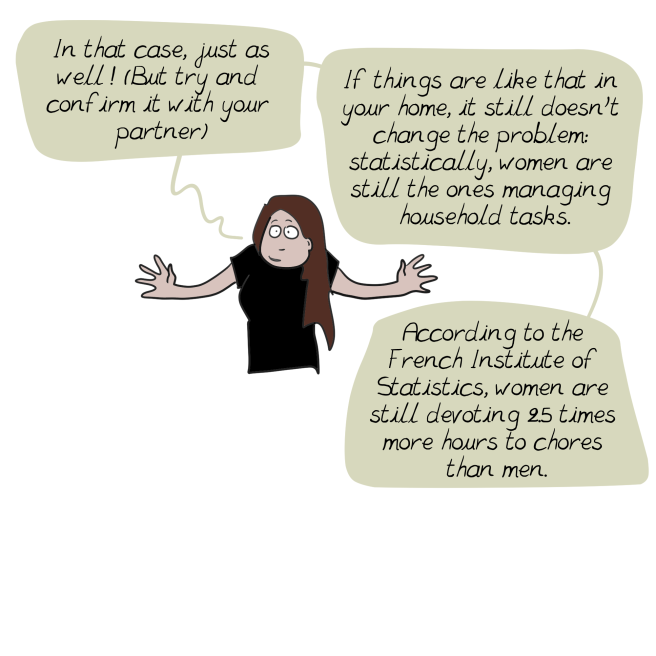
You might have missed this: “According to the French Institute of Statistics, women are still devoting 2.5 times more hours to chores than men.” And if you bother to check the statistics, considering women that work part-time, women only worked on average 53 minutes less than men. And spent 50 minutes doing more housework, on 27% more days than men. So it doesn’t even out.
If you don’t take into consideration what you’re reading then it makes you look narrow-minded and makes us think you have no grasp of the bigger picture. Just typing words that fit your own narrative.
LikeLike
Oh Jonathan … this article isn’t about women who are full-time home-makers. It’s about the extra burden that women carry even when we are “working our arse off to pay for it” full time ourselves. So no, not a narrow-minded or manipulated narrative, but a true burden that so many men—you included, it would seem—have no concept of.
LikeLike
Curious – if the woman is staying at home with the children and to run the household are they still taking turns to get up in the middle of the night to feed the baby (provided it’s not EBF?) if not then this is still quite true. To not get up in the middle of the night because “she stays home” doesn’t recognize that it’s her job to do these things and that she needs a solid night sleep too. Too often I hear “well I get up because I stay home” – but if she is working and running the house hold her sleep is just as important. I would also argue that if someone is staying home then that’s great – but just because she/he is staying home doesn’t mean everything falls to the person at home. People with 8-5 or 7-6 or whatever hours they want get breaks and SAHM (or Dads) don’t. Kids don’t care. If there aren’t kids there’s a different story. There are a million different scenarios but the point remains that a lot of times the unseen work is just that – unseen and unrecognized as such.
LikeLike
This might be true if a stay-at-home mom worked an 8 or 10 hour day. But it’s more like a 16 hour day. And, you would have to hire at least two full time people to do the work of a stay at home mom. Even with that you would still need to pitch in. If you don’t believe my I dare you to be the stay at home parent for one week while your wife does as much as you do now.
LikeLike
Fair enough statement, however I must ask, just how many spouses who come home from “working their arse off”, continue to do the household work and childcare duties until they go to bed? Stay at home parents’ (usually moms) duties don’t end at some “clock out” time in the early evening. They don’t get to leave their worksite and go to some comfortable location where they can toss their coat, kick off their shoes and wait for someone to have dinner on the table for them, and relax afterward knowing that “somehow” all the household chores will have been taken care of.
LikeLike
Sorry Jonathan – but I don’t think you quite get this. When I was a stay- at- home Mom of 4 I did everything but my husband felt he should do less when he got home because he “worked.” I continued to work all evening and into the night as children awoke etc. I didn’t sleep for years. As years passed, I then worked as a professional outside home earning more than my husband but I still carried on with household work. My husband did very little even tho he was asked over and over. I also discovered that as stressful as my employment was, it did not come close to the drudgery of raising a family and working in the home. I’m sorry but you don’t see the bigger pic. If she’s still at it – so should you be. You are not of more value than she is and what you do is not of more value than what she does. She doesn’t get to slack up on chores because she’s been working all day and neither should you. When you are home from “work” your job is not done. You are a team. So if she’s still working – so should you. Then you’d get the bigger picture.
LikeLike
Except that many women work full time jobs and still come home to do 95% of the work. I’ve been I situations where I was stay at home, PT worker, FT worker, FT with OT, and my spouse had been in situations where he was stay at home, PT, FT.. and the workload has never changed.
LikeLike
I think you’ll find that the majority of women who do work full time and have children still take care of the vast majority of the household work which needs to be done. And that can be flipped as well, there are now women who work full time and dads who stay home with the kids and in that household, I imagine he is the one doing all of this mind juggling.
LikeLike
Thank you so much for your explaining. It’s all much clearer now.
LikeLike
If by “biased” you mean confirming and validating many women’s realities, then yes, sir you are correct. This obviously wasn’t written to describe couples who feel that the weight is evenly distributed in their household. You are completely missing the point; and frankly seem offended. I suspect that its because this might just be a very comprehensive and fair illustration of what many of us are struggling to voice.
As for your comment about equality, “if things were equal…” it pains me to see that you somehow are mistaking household work as less valuable than work outside of the home. However, this is exactly the type of mindset that is excellent candidacy for change.
LikeLike
She mentions it actually. “Even when they go back to work…”
LikeLike
What? Read the first opening sentence again, slowly. If that’s too much of a mental work, let me rephrase them, “a colleague from her first job”
LikeLike
Your argument is a rarity these days:
https://www.google.com/amp/s/www.washingtonpost.com/amphtml/news/wonk/wp/2016/12/22/the-days-of-stay-at-home-moms-are-long-gone-data-show/
LikeLike
This comic SPECIFICALLY refers to women who also have jobs. If a wife and a husband both work, it is still expected that the woman will take care of the children and clean the house. That’s what this is about–unequal distribution of work. I agree with you that if a couple agrees for the woman to be a stay-at-home mom, then yes of course that is what her job will be. But if she has a career and is still expected to do the duties of a stay-at-home mom, it would get overwhelming and exhausting.
LikeLike
And you just typed words that fit your own narrative.
LikeLike
Nor does it mention the situation where the woman has a job and the man stays home and takes care of only part of the household chores….and the woman still does the management in addition to much of the chore load, even if not all of it. This second shift is exhausting. Most women anymore work outside the home as well as parent.
LikeLike
What makes you think “the woman” doesn’t have a full-time job too? Other than the short period of maternity leave, there is no suggestion that “the woman” isn’t working full-time.
Even if the woman works longer hours in paid work than the man, you can be sure that she will usually still be the one carrying the mental load.
In this day and age, where most women have been part of the workforce, and often in similar positions/industries as their partners, the suggestion that “the man” has been “working his arse off” and so deserves respite after work is ridiculous.
Women know exactly what working full-time entails, they also know that looking after babies and children for 8 hours plus the full mental load of a family household is a lot harder than doing most 9 to 5 jobs, and taking primary reponsibility for babies snd toddlers for 24/7, without a break (other than when the dad plays with the baby while the mum cooks dinner – such an awesome break, she should be so grateful) is a hell of a lit harder than just about any full-time job.
If the father is working full time, and the mother is not in paid employment, then it is fair that for the hours he is working she takes care of the house and children. That means they are both doing equal work.
Every moment that the father is not at work all parenting, household duties, and mental load shoild be shared equally between them.
Anything less is grossly unjustifiable.
LikeLike
You’re arguing with words that seem to fit the authors narrative, but really, you’re arguing the *rare* exception, trying to prove that because the author didn’t say “but not all men” she is lumping all men together.
What you are actually accomplishing by defending the status quo is acknowledging that there is a rare exception-which means the thing the author is pointing out happens all to often.
I recommend that rather than dig your heels in to maintain the inequality, you look for ways to make life more equitable at home- pick up the towel, put away the veggies, do SOMETHING for the house without having to be asked.
And push attention to how much effort you put into figuring ought what you can do… And then multiply it by 1000- because that’s the amount of work done by female heads of households, when their make counterparts are saying “just tell me what you need done”.
LikeLike
In most cases women are working too.
LikeLike
I worked my arse off to pay for it all with my kids while my then husband was home with the kids. I still ended up managing the household as well. Just saying. A simple financial role reversal doesn’t always work so simply.
LikeLike
The problem is women are more likely not to go back to their job or find a new one after pregnancy because of the pressure they feel to be the ones to solely bring up their children. It’s the stereotype that men HAVE to be the ones who are the majority of income earners that tends to make these women feel like it’s their only option, to stay at home and be the one to make all the household work get done, by herself or otherwise.
Also, often even before a couple has a child, people have this preconception that women are the ones that should still be in charge of the household work. So, I’m sorry that some men have full-time jobs and have to share some of the lists of hectic household chores women do on a regular basis. Looking after children for a full day or coming home from a days work to organise everyone in the family, including your own partner isn’t a one person job (or more likely a one woman job). All the author appears to be saying is the burden and thought about these chores should be shared by both partners, not burdening one of the pair.
LikeLike
Except when: you come home after a hard day’s work, the mother of your children is working overtime to feed you, feed your children, put your kids to bed, read them a bed time story, and then wake up in the middle of the night if there’s ever anything wrong with them. Not to mention weekends, when you get to go relaxing with your buds, but your wife is working to keep your children alive and your house in order.
No, the cartoon is not biased. You are.
LikeLike
This is talking about women who carry the mental load and also have to go back to work. Women are often conditioned to take on the mental load and so the family system falls into gender stereotypes. Perhaps you should pay more attention when you read. I mean, this is a cartoon. Put in some effort.
LikeLike
Not biased, just a point of view! For example, your reply could come across as biased and misogynistic due to your one sided view of ‘when he works (‘his arse off to pay for it all’) and she therefore does the housework’.
What about the other way around? I know of a bunch of house husbands who still don’t participate in the emotional load despite having the time and means to do so. I’ve seen kids who take longer to learn to speak because the dad will do the basic childcare stuff then disappear into another room/onto the computer rather than natter to the young child whilst doing chores in the same room. I’ve seen the housework being basically done by the house husband but only if the working wife leaves lists (thus still having to project manage).
It’s not always like this, of course. The point of the post is to educate those people who don’t already know this stuff in a way that helps us all. Teach these women types to help let things go, and teach the men of these types to to see the affect they’re having on the family they love.
LikeLike
In today’s world, in most of the USA at least, both partners have full time jobs. The man probably does earn more but that does not mean he works harder.
And even if a mom is stay-at-home, that means her job literally is 24/7, and it is hard work. Being a stay-at-home mom is not at all necessarily less work than an away from home job.
So, whether the mom works outside the home or is a stay-at-home mom, both parents are working their asses off 9-5. But it’s the mom, statistically speaking, who is also working their ass off before 9 and after 5.
LikeLike
(Face palm). You’ve completely missed the point! This article is relevant to the situation you describe. Even more so because the man has a wife at home so often completely checks out of doing anything but the bare minimum at home. Studies have found that if you add up all the hours of work both inside & outside of the home, the wife is still doing more than the husband, even if she is a stay at home wife. I so often hear stay at home wives complaining that their husband is out on weekends to watch or play sport (or pursue a hobby) & she’s stuck at home dealing with the kids / house. The justification from the man being he needs down time after a busy week at work (fair enough) but why does the woman not get equal downtime?
The Wife Drought by Annabel Crabb is a great book that covers all of this & backs it up with statistics, studies etc etc.
LikeLike
“Biased”, I don’t think so. Think about what it means for one partner to stay home and take care of the household while the other is outside doing another job. Both are jobs. Both are full time, One is paid. When the one outside comes home, he or she is then an equal partner in the home and can contribute on that basis. Narrow-minded is considering only paid work to be worthwhile and somehow privileges the worker as exempt from participating in the shared space. The partner working outside during the day would not long get away with such a “it’s not my job” attitude in their paid employment.
LikeLike
YES YOUR SO RIGHT
LikeLike
Hi Jonathan,
It’s true that men are still more often in the ‘bread winner’ role (lots of systemic issues that lead to that outcome, but that’s for another topic). But even when the earning time is more even our socialisation still means that women do the ‘mental load’ discussed in the article.
I’m really glad to have seen this as it does describe this very real experience. I could never quite put my finger on it before.
Case in point, I do paid work 50%, my husband 60%. I have one day a fortnight where I am neither at work or wrangling the toddler and I spend that day catching up on errands for the household; he has one day a fortnight where he has responsibility for the toddler (and usually his mum comes over for a couple of hours to help him) and when I come home toddler is happy, but the dishes are still in the sink, the laundry is still on the clothes line, the house is chaos, and I have bought dinner provisions which I then cook (after feeding the toddler).
If I asked him to empty the dishwasher he would do it. But I don’t want to give him a list of all the things he could/ should do as i don’t want his daddy day to feel pressured. But I would like him to see things need doing and do them.
He’s a damn fine dad and partner.
But I am the manager. And it’s exhausting.
LikeLike
It also covers working mothers if you read again carefully. Working or not mothers so bear a mental load. Recognizing that and helping out can make life more enjoyable and worth it for the entire family.
LikeLike
Difference is that the man often stops working when he leaves work, gets breaks (even just 5 minutes!) at work and comes home often with expectations on what everything should look like without taking a significant responsibility.
And I know what it’s like to be the bread winner, because I am, and I am the mom. It’s not the same as being a man and the breadwinner.
LikeLike
I’m a stay at home mom and I agree, the dynamics are a bit different, but that’s still no justification for completely ‘checking out’ of domestic responsibility. My husband wouldn’t even add an item to the shopping list and would then complain that I was mishandling the house when he didn’t have the brand of tea that only he uses.
LikeLike
Jonathan Hings I can’t believe you said that. All my married life I worked in a full time paid job just like my husband, as did all of my female friends. I cannot think of any that didn’t. As well as working and contributing just as much money to the running of the household just as much as he did, I also managed the household and looked after the kids. Your comment makes you narrow minded as well as blind. I hope you’re not married.
LikeLike
I think the point is just about taking initiative in the home, not waiting to be told.
I work on site, and it’s the difference between working alongside someone who knows the job and what needs doing and just gets on with it, and having a labourer who stands next to you on their phone until you tell them exactly what to do.
It’s not necessarily about exact divisions of labour, which change according to who works/longer hours etc, it’s about one person having to take all the responsibility for running the house.
LikeLike
You’re biased if you assume the man has a full time job and the woman doesn’t! If you don’t take into considerations outside the household then it makes you look narrow-minded and makes us think you have no grasp of the bigger picture. Just typing words that fit your own narrative.
LikeLike
If by “biased” you mean “does not apply to everyone” then yes. But the story is not wrong either. It doesn’t say anywhere that in the case of one member of the couple doesn’t work they should still balance the household workload. The story is about balance.
Maybe it just needs some context : the original version was in French for French readers, where 15% of women of 20-59 years are housewives ; and most of them had a job at some point in their lives. Most of the population know what it is to have both work in the couple, even though they are not all in such a couple right now.
LikeLike
it’s pretty clear here that both are working parents.
LikeLike
Hey bud. With respect, you’re missing the point. The point is that its not just the duties themselves (washing dishes etc) that need to be fairly apportioned. Its the responsibility (i.e. mental load) which needs to be shared. Its not an attack on men – and if you feel that it is it says more about you than about the article.
LikeLike
What dream land are you referring to? Since when do women always have the luxury of not working and making their primary role in the family home
Making? And exactly how many hours a day do you think go into that?
It’s not exactly a 9-5 job running a household. Or even 8-6. Or even 7-7! No. It starts the moment the children wake up until they are in bed and asleep and then it often still continues with the woman completing tasks she couldn’t complete while the children were awake. Like folding laundry, paying bills, or doing dishes and preparing lunches for the next day.
I think you have some things a bit mixed up in your thinking. Good try though.
LikeLike
The article didn’t say one way or the other if either the male or female work full-time or not. It actually left it up to speculation because it’s not really the point. You just full on perpetuated the myth that women should be able to handle the household and kids I’d they don’t work. Did you read the whole thing? Even in situations where both man and woman work full-time and have kids the woman is always more likely to carry the burden of constant worry and remembering everything.
LikeLike
Thank you for this. Me and my partner are struggling trying to change e make our home more equal. We alrealdy are far from some stereotypes, but there’s still much to improve ahead. Finally, I would like to translate your work to Brazilian portuguese, even though I’m not a professional. I believe it’s going to make a great difference in many women’s lives in here. Thanks a lot!
LikeLiked by 1 person
I was disgruntled with domestic duties until my husband tragically died in a road collision leaving me with four small children and then I realised how much he did with a lot of goodwill – don’t make your home a battleground – appreciate each other’s efforts and muddle along together – it’s give and take ❤️
LikeLiked by 4 people
I’m sorry but you’re only sentimental because of the tragedy.
Downplaying or invalidating the way women feel about this and the very REAL affect it has on our day-to-day lives or indeed, the amount of times it leads to separation, doesn’t help.
LikeLike
Thank you for commenting. Your family is in my thoughts.
LikeLike
I can understand this point of view, but I don’t let it dictate my feelings about what is happening in my life *right now* either. My husband has medical issues that could become major issues very quickly. But we are still living our lives right now — I have a right to feel anger and frustration about situations that are happening in my household.
I’m more concerned about the fact that if *I* died tomorrow, our household would completely fall apart. Of course those of us who are married and love our partners despite this very real issue don’t want them to die. We know this would be a bad thing. But this isn’t an excuse for what really amounts to emotional abuse.
Surely you aren’t asking women to ignore these issues because someday their spouse could die. And I’m sure you also must realize that even if your spouse was doing everything right and you just didn’t notice, that may not actually be the case for everyone with whom this article resonates.
LikeLike
Housework is not the only task to balance on the family “fairness” scales – eg. there’s parenting and earning. And sorry, but household management with primary aged kids is nowhere near as much of a mental load compared to a professional job. I’ve been a househusband with a number of primary aged kids, and I had mental energy and even time left over, unlike when I was a full-time professional. 2 dishwasher load/unloads and 3-4 laundry loads per day and the stagnant circling of local supermarkets does make much of your life dull and plodding, but it’s worthwhile and temporary eh? Not that I’m expecting some of these commentators to listen to a bloke.
LikeLiked by 2 people
How about a situation where both partners have professional jobs? As I thought that’s the level that mostly was discussed in the comic
LikeLike
Aw, you poor hard done by bloke. #notallmen
LikeLike
Women in the United States are doing both. We have no parental leave, so women are working professional jobs sometimes days after giving birth and doing all this household management. Many men are just working.
LikeLike
Can you point me to where this is talking about “housewives”? Most women with primary aged kids also work full-time outside the home.
LikeLike
Your lived experience is not universal. Also, why are you assuming that the women in these situations doesn’t work?
LikeLike
You’re right. Not really interested in listening to a bloke when thousands of women feel otherwise.
And the fact you mentioned shopping and dishwasher unloading as the main tasks you performed, makes me wonder how much other invisible tasks SHE took on.
Also no mention of the disgruntle women feel that they’re put into positions of drudgery because somehow her gender assigns that to her and subliminally she resents that her partner lets her fall into that role happily.
LikeLike
See Justme’s reply below.
LikeLike
Except the vast majority of households these days are two-income households, meaning both partners work and yet mom is still expected to take care of duties at home. Having one person stay at home is a luxury in today’s economy.
LikeLike
My husband stayed home for 6 months when my child was 7months old when I returned to work. He had “his turn” as he says. He thought it was easy. Yes it was – because he didn’t do a quarter the stuff that I would do in his position. Do you think going to the supermarket occasionally (did you plan the meal plans and lunchboxes for the week?) and dropping kids at school is managing? Who bought all the birthday presents (kids and friends), who organised parties?, who organised extra curriculurs? Who made sure uniforms were clean and in the cupboards? Who bought the kids new clothes when they grew out of them? Who did homework with the kids? Who discussed issues with the teacher? Who enrolled children into school? Who got the kids booklists? Organised costumes for concerts? Who cleaned the toilets, the bathroom? Who got the kids hair bands and ribbons? Who are the kids “go to” for everything? My kids will walk past my husband to find me in the toilet to ask for a bloody drink!!!!
I am not saying men can’t do it – my dad raised me and my sister as a single father where he did everything – but statistically it is not the normal and men need to realise that their perceptions of “equal share” may not actually be equal.
You have entirely missed the point of this article – women are working too! women are still expected to do not just the physical everything but the mental everything too! Men are quite happy to help – if they are given instructions on what to do. THAT is exhausting and a full time job. The household is like a project in a professional office – but a project that NEVER leaves you alone.
LikeLiked by 1 person
I dunno, after the first three months with our newborn my husband openly said ‘it seems a hundred times easier for me to go off to the office each day than to stay here and take care of the baby all day. I wouldn’t trade places with you for a million dollars.’ 🙂 I’m sure everyone is different but taking care of house and kids 24/7 is a specific type of mental drudgery. Now we both work and our kid is in school (SK) and honestly Monday morning is a specific sort of bliss! For both of us. And our kid is wonderful. But very high-energy, and absolutely draining.
LikeLike
Ugh. Just- ugh. So you weren’t responsible for *actually cleaning the house properly*? Who was? Who organised that? Who organised the activities for the children, buying their clothes, making sure that anything that comes up was explored and addressed, that medical, dental and wellness appointments were *made and kept*, that the emotional and psychological needs of ALL the individuals in the household were being addressed in the best way for *each individual*- the list goes on.
To minimise the ACTUAL energy that is required in looking after a household and all its inhabitants well *while trying to maintain a relationship with one’s self AND one’s partner* as ‘2 dishwasher loads/unloads, 3-4 laundry loads… and [shopping]’ is an indicator that if your partner was the one working they were ALSO the one still doing the mental work of household management. To write this and then use the passive aggressive ‘listen to a bloke’ comment at the end also further highlights the attitude inherent in your comment.
LikeLike
You do realize that this still happens when both partners have a professional job? – In my family, we’re both at the same level, in the same pay grade, and my husband does half of the physical chores and is great with the kids – but still I’m the one who manages all the lists for healthcare, school stuff, summer camps, vacations, … and that example with “cleaning the table” hits right home.
LikeLike
Of course it was easy – Your wife/partner still carried the mental load, and did most of the work by the sounds of it.
LikeLike
In most cases these days both people work outside the home. Most of this is about the mental burden that happens above and beyond the job.
LikeLike
Before becoming a stay-at-home mom, I owned a brick and mortar business. It was a service / retail hybrid and I did everything myself… Recruited and managed both employees and volunteers, managed inventory, did all the accounting, paid monthly and quarterly taxes, interfaced with customers, etc. Staying home with two kids and managing the household is still far more mentally exhausting. If you think working a 9-5 job is harder than being home with kids, I can GUARANTEE you that it’s because your partner is still the one doing the mental work of managing the household–regardless of who’s staying home with the kids.
LikeLike
Before becoming a stay-at-home mom, I owned a brick and mortar business. It was a service / retail hybrid and I did everything myself… Recruited and managed both employees and volunteers, managed inventory, did all the accounting, paid monthly and quarterly taxes, interfaced with customers, etc. Staying home with two kids and managing the household is still far more mentally exhausting. If you think working a 9-5 job is harder than being home with kids, I can GUARANTEE you that it’s because your partner is still the one doing the mental work of managing the household–regardless of who’s staying home with the kids.
LikeLike
Jeez. You are proving the point again in your post. Not only do you seem to, incorrectly, think that everyone here is a feminazi who doesn’t want to listen to a man (so incorrect btw – feminists are about equality!), but you seem to think that laundry, dishwashers, shopping and childcare is he extent of being the stay-at-home partner! There’s more to it than that. Jobs are hard. Staying at home is hard. But if you still leave a lot of the emotional load to your partner then staying at home seems easy! And some jobs are easy when you have a easy life to come home to!
LikeLike
Wow, cool, so this doesn’t apply to every single man? The entire comic is invalid because of your personal experience! I’d like to send you a #notallmen award. Will you be in the kitchen or laundry room to take delivery?
LikeLike
Great Read, thanks!
I’ve thought about this quite often myself. As a man with a busy wife, I notice, that she kind of corralled the responsibility onto herself. I don’t get asked or even informed a lot of the time. Things happen and I can only ask why and what for. Her fear of things not getting done, cause her to not want to give up any of the responsibilities, even though I am more than willing to take them upon myself.
How can we break this cycle?
Greetings from Germany
Jacob
LikeLiked by 4 people
The comic literally tells you how. Step up and do things. It’s about how you shouldn’t need to be asked or informed. If you see a messy table, tidy it up. If you see vegetables out, put them away. Pretty straightforward.
LikeLike
Why do you need to be asked to load or unload a dishwasher? Do you not see the dirty or clean dishes sitting there? I refuse to believe she literally runs to complete all chores the moment they become chores just so you don’t have to get to them first. Walk up first, begin task. If you somehow do not understand how to fold or where to put things in your own home or what brand of the food you eat weekly to buy, ask while you are in-task. If she summers about doing it herself, ask her if she thinks you are incapable and if no, then continue. If yes, ask her to help you change that. Chores are not rocket science. Just get up and clean???
LikeLike
Don’t wait to get asked!! Just do what needs to be done, but do it 100%. My husband will “do the dishes” and declare kitchen work done for the night, but missed the cups that got left on the table. And the pots/pans in the stove. And will leave a big bowl or cup in the sink with soapy water and silverware in it. And won’t have emptied the dish drainer/dishwasher first, so now all the previously dry dishes are wet again. And won’t have wiped down the counters. He will cook dinner, then leave all the spills and dirty dishes and leftover food in the pans on the stove. We (women) get frustrated at having to explain what should be obvious, like when you do the dishes, do ALL of them, not just the ones that are in the actual sink. So we find it easier, usually, to just do it ourselves rather than go over it and over it and over it to an ADULT who is perfectly capable of figuring it out by himself, which is what he’d do if we weren’t there, but because we are there he expects us to hold his hand and teach him like he’s our child.
Basically, you KNOW what needs to be done already, and forcing us to ask you demeans our “partnership” to that of boss and employee. You’re my PARTNER. Equal. I shouldn’t HAVE to ask you to go get more milk when we are out and you work next to the grocery store. I shouldn’t have to ask you to put dirty laundry in the hamper. I shouldn’t have to ask you to put dirty dishes in the sink. You should just step up and do it.
LikeLiked by 1 person
Just do it. Why do you need to be asked? This is exactly the point of this article.
LikeLike
Hey Jacob, I would say just start doing things. Toilet paper ran out? If you noticed first, buy toilet paper and text her so she doesn’t buy it when she’s out. Windows dirty? Wash them. Do the chores that you notice need doing. Once she sees that you notice and take responsibility yourself she will likely communicate gratitude. If you decide to do something that involves her personal belongings, like laundry, just make sure to communicate beforehand. My husband shrunk a shirt once that shouldn’t go in the drier. Best of luck!
LikeLike
Just do it/them! start doing obvious things (put clean dishes away, watch the kids when she’s cooking, etc.) but do things she would do so that it is truly a relief for her when you do it. Or, act interested and get involved! Ask what you can do!
LikeLike
Good point – maybe you can ask her to take care of specific “subroutines” – for example, my husband has started to take care of the dentist’s appointments and the homework monitoring he’s starting to branch out from there. Being from Germany myself (although I now live in the U.S.) Germany is also “mommy guilt” central. Never experienced the level of weird comments and snide remarks about having a full time job until I spent a sabbatical in Germany.
LikeLike
So true. I went through that myself, after our first kid, wherein I felt like it was all up to me to make the kid survive. I think the trick is to realise that both parents are in it together and be willing to share the load without insisting that your husband do things the same way you would or at the same time. But I’d also attribute it to his attitude – after a while he stopped asking what he could do to ‘help’ and just noticing what needed to be done and did it. Over the years the load has become pretty equal, in fact I’d say my husband carries a bit more of it than I do.
LikeLike
You said something very important! I’m an old grandma and I’ve seen women make this ‘mistake’ often. We tend to feel the responsibility is on us and nothing is perfect so we drive our partners away from assisting in real meaningful ways that would generally relieve us, and make them feel confident in their competence. First step is recognition, own discussion and changing a few little behaviors. It works! I still loved my husband 40+years later. The point is he wants to change this cycle and I just be willing to as well. 😊
LikeLike
Hi Jacob! Have you considered sitting down with her and making a chore chart? I’m sure she’d at least let you take on some of the more tedious tasks.
LikeLike
Even when my husband stayed home with our children and I went to work, the mental load was all borne by me. In fact, he behaved like a teenage babysitter — making as many messes as he cleaned, ignoring important tasks, taking phone messages for me to resolve when I got home from work instead of solving them himself. He gave my children tremendously beneficial attention and fun, but he patted himself on the back for every dish he did or laundry load he ran, without seeing these tasks to completion or doing the real work required to run a household — that was left up to me, while I worked full time and climbed the professional ladder.
However, it was off-limits for me to bring this up as an issue because he would become defensive and claim I was ‘minimizing’ his labor. It was an unwinnable argument, and he still feels resentment over it although our kids are now 10 and 13. Also, he frequently accused me of taking on the role of manager, theorizing it was because I am accustomed to managing things at work. There was no convincing him that he was taking on the role of underling, which then gave me little choice but to manage him or we would all suffer. I tried leaving tasks for him to notice and take them on, and all that happened was we ran completely out of necessary resources, bills went unpaid, toilets unscrubbed until they were green. But we was blind to it, and deeply resentful if I tried to change the power dynamic.
My husband considers himself a staunch feminist ally, but he is incredibly hostile to even considering that he does these things. I could never share this cartoon with him, which makes me very sad.
LikeLiked by 2 people
You are not alone! I am going through the same thing in my home. It’s just easier to do everything myself then try to argue or persuade him to see/do things differently and take on more. The worst part is when he needs time to recoup- in front of the tv – while dishes, laundry and kids need attention!
LikeLike
Did I write this and forget? Do we have the same husband?
LikeLike
Oh my goodness, this is word for word the behavior of my dad. My parents were together for 25 years before my mom decided enough was enough and divorced him. He never acted like a father, and when they got divorced and no one would talk to him but me, it was almost like he expected me to mother and take care of him. Absolutely useless. He never felt like he was my parent. I went to my mom for everything, because he refused to be motivated for anything that wasn’t directly impactful to him.
LikeLike
All of this is so true! And then if you miss one thing, that is the the one thing that is noticed. And you’re like, “what about the 75 other things I did today that no one paid attention to!”
LikeLiked by 2 people
Reblogged this on Interpretations.
LikeLike
This is great! So well explained and developed. Have you considered translating it? I would love to be able to share it with non-english speaking people.
LikeLike
Would love to see a Spanish version!
LikeLike
Would love to see a Spanish version of this!
LikeLike
Reblogged this on Crappy Living and commented:
Such a good summary of the conversations I have had over and over again for the last 6 years. This doesn’t quite match up with my situation. And I don’t share the ‘mental load’ equally in other areas of our lives together. But elements of it ring a lot of bells and it’s well worth a read.
LikeLike
This is great. 🙂
LikeLike
Yes and oh yes.
LikeLike
I don’t carry more than my share of the mental load in my household. Of course, the place is a disaster sometimes, but I just refuse to do it if I’ve already been doing enough chores. Eventually my husband gets annoyed at the mess and cleans it up himself. Ladies, the best way to get your husbands to help out is to just refuse to do all the work. He’s going to want clean clothing and clean dishes to eat off of eventually. If it’s his turn to do it, just wait him out. It works.
LikeLiked by 1 person
I started this a few years ago. It works, but I’ve really had to lower my expectations for cleanliness.
LikeLike
ha! Definitely! LOL
LikeLike
“Help out” is not what a person with an equal share of the mental load does around the house. Saying that a man “helps out” assumes that you are in charge of everything and he lends a hand.
LikeLike
I really think you’re getting overly sensitive at the phrasing here. I help out. He helps out. We help each other out. Phrasing. Chill out.
LikeLike
I actually think the choice of wording here matters quite a bit, and definitely sets the tone and a subconsciously held impression of whose responsibility the work really is. One partner isn’t doing another partner a “favor” by pulling their weight. Maintaining the household and whatever that entails is a shared responsibility. Which means you should both continue to say “please” and “thank you” because politeness is good for a relationship, but both parties are expected to help where help is needed, and nobody is “helping the other person out” by doing a household chore.
LikeLike
I’m not going to get into an argument on the internet because it doesn’t ever end well, but I’ll just say that I disagree. My husband and I have an equal distribution of labor and I definitely don’t carry the mental burden of these chores, and yet the phrase, “help out” is often used in our household by both of us. Perhaps it’s different in other households, but you can’t paint all situations in black and white because it’s simply not the case.
LikeLike
Agreed! I stopped doing his laundry altogether (seriously, a grown man can do his own laundry- nobody has done mine since I was a teen, and that’s the way it should be!) and I no longer do the dishes if he skips his days. I let them pile up until he finally does them. While I’m not a fan of dishes in the sink, it beats begging for help over and over or taking on too much myself.
I do still carry more of the mental load, since I’m taking care of all budgeting and bills (I don’t want our credit going to shit), and also meal planning (which I’d give up on too, but don’t have a choice there, because we don’t have the money to go over budget), but I think he’s coming around slowly. He’s an awesome father, and good partner, but it seems like even the good ones can’t escape the scars of living in a toxic patriarchy and growing up in a land of systemic sexism.
LikeLiked by 1 person
Yes, this! My husband is wonderful and sensitive to these things, but even he sometimes needs a reminder. I’ve definitely eaten off of paper plates a few times because it was his turn to do the dishes and they weren’t done. It is what it is.
LikeLike
This!
I’ve never been shy about, letting dishes pile up (occasionally washing one for myself) if I feel I’ve been shouldering more chores than is fair – or plopping a crying baby next to my sleeping husband if it’s my turn to get some sleep.
(I imagine people reading this and thinking it’s selfish or a bad way of being in a relationship. To this, I shrug. I feel I’m putting the health of our marriage first by avoiding burnout and resentment and by keeping both partner’s needs in mind.)
Although, I have to say, one thing that makes this work in my relationship is my husband being sensitive to mess and me being pretty blind to it. The dynamic is usually reversed.
LikeLiked by 1 person
Good for you! The thing is, if you’re stressed and resentful about pulling more than your share, that’s not good for the marriage either. I know for me, I entered into a partnership, and for me partners means we share the load. It does help to be able to tolerate a little chaos, for sure!
LikeLike
God I wish this was an option. Mine would just leave the mess if I didn’t clean.
Believe me, I’ve tried, and he’s told me as much.
LikeLiked by 1 person
Yeah, I think it comes down to how much you can tolerate the mess. I’ll clean my fair share, but we both work so I’ll just leave it there in a big messy pile if I have to. That’s a bummer 😦
LikeLike
Brilliant article! Just had a baby girl 2 months ago and all I seem to be doing is cleaning up and mentally planning the next task while getting lost on the way as I see a heap of crap lying around!
LikeLike
Leave him with the baby. Leave him with the baby for hours. Don’t give him instructions. Don’t respond to questions he can figure out on his own.
Let the dishes pile up. Assume he’ll be doing all the research on childcare. Trust his judgment. When she outgrows her first carseat, shrug and say, gosh, I wonder if they make bigger ones?
LikeLike
I’ve just shown this to my youth worker husband (he is the rare man that doesn’t do this) and he would love to use a printed version in his boys group?
Would you be okay with this? – or do you have resources for sale?
LikeLike
I can’t wait to read about “emotional work”!
LikeLike
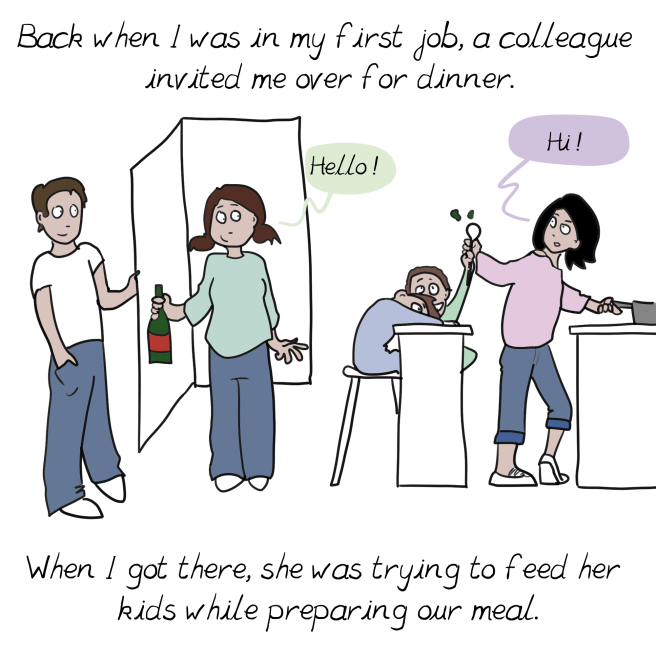
I made an attempt to a transcript so more people can read this. Here it is :
Back when I was in my first job, a colleague invited me over for dinner.
Narrator, arriving at the door: Hello !
*Three people are in the room: Two kids are around the table, An adult with short hair opens the door, another one with longer hair is making food and taking a spoon from a kid’s hands.*
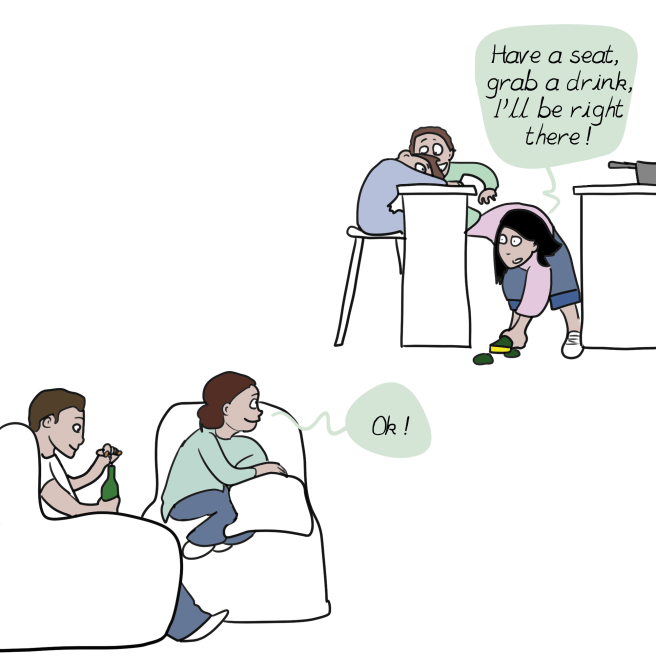
When I got there, she was trying to feed her kids while preparing our meals.
The colleague: Have a seat, grab a drink, I’ll be right there !
Narrator: Ok
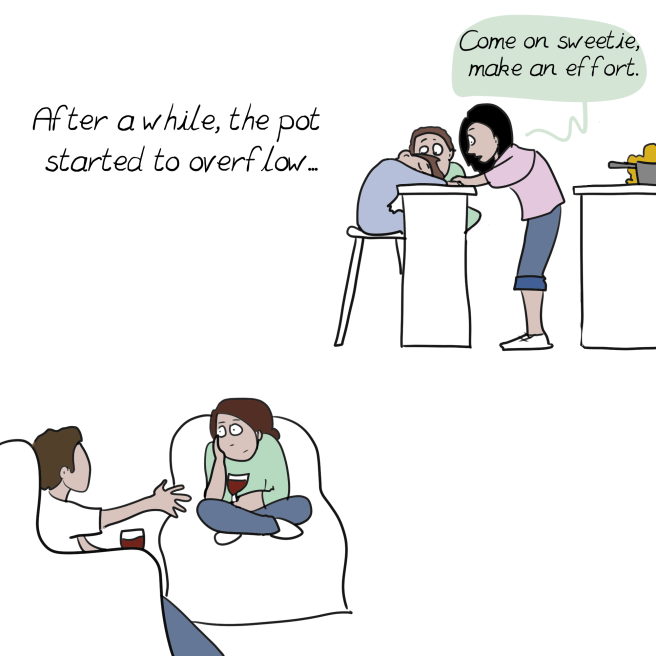
After a while, the pot started to overflow…
The colleague, attending to a kid: Come on sweetie, make an effort.
*The narrator and the other adult are talking in armchairs, drinking wine.*
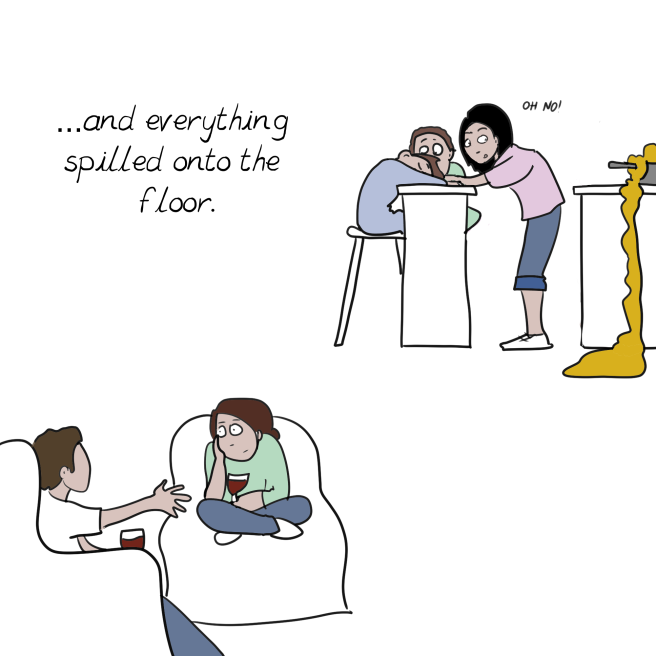
…and everything spilled onto the floor.
Colleague: Oh no !
*The pot is overflowing a bubbly yellow liquid.*
*The colleague is still attending to the kids.*
*The narrator and the other adult were still talking in armchairs, drinking wine.*
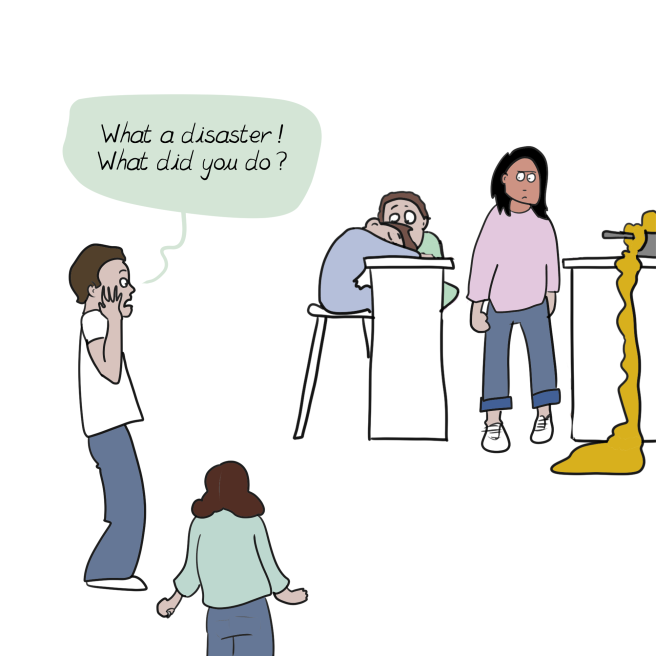
Other adult: What a disaster ! What did you do ?
*The colleague looks at them unhappily*
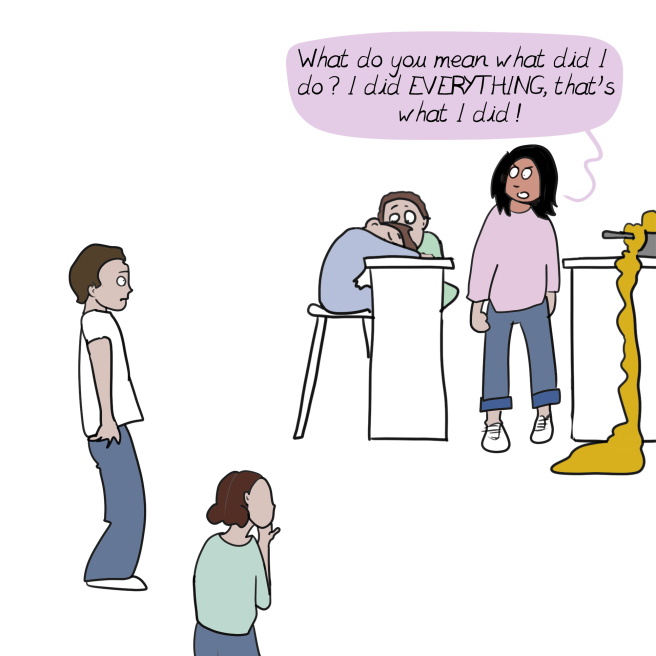
Colleague, angry: What do you mean what did I do ? I did EVERYTHING, that’s what I did !
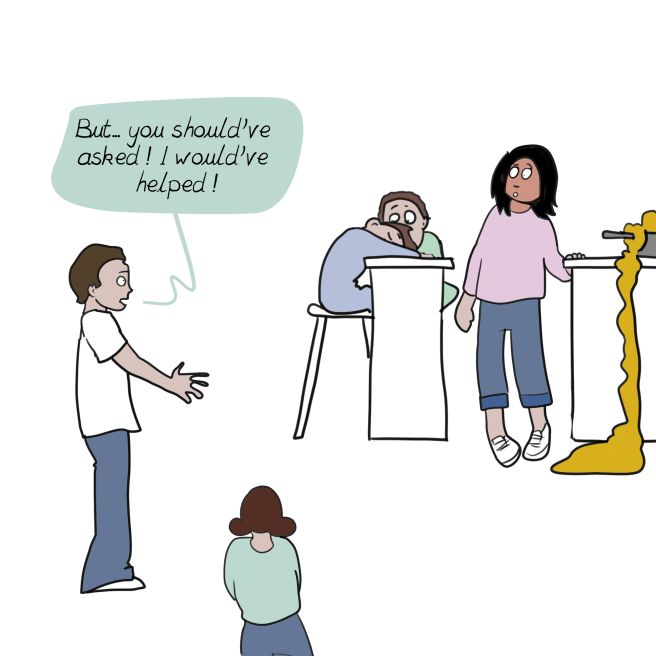
Other adult: But… you should’ve asked ! I would’ve helped !
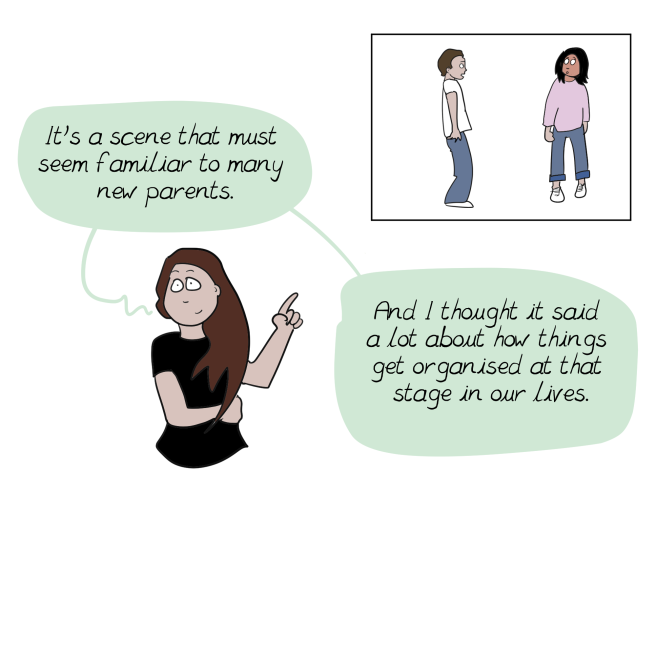
Narrator, meta comment: It’s a scene that must seem familiar to many new parents. And I thought it said a lot about how things get organised at that stage in our lives.
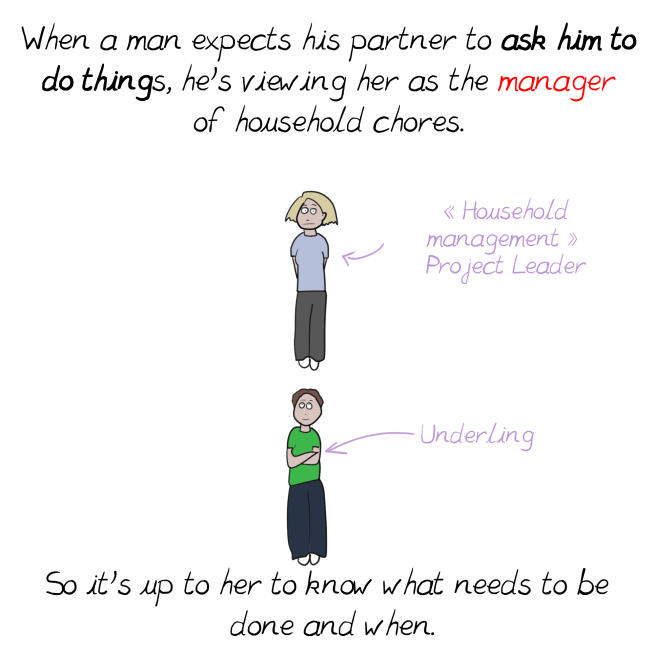
When a man expects his partner to **ask him to do things**, he’s viewing her as the manager of hoursehold chores.
*Two drawings of peoples: One is labeled: “Household management” Project Leader, another one with shorter hair is labeled “Underling”.*
So it’s up to her to know what needs to be done and when.
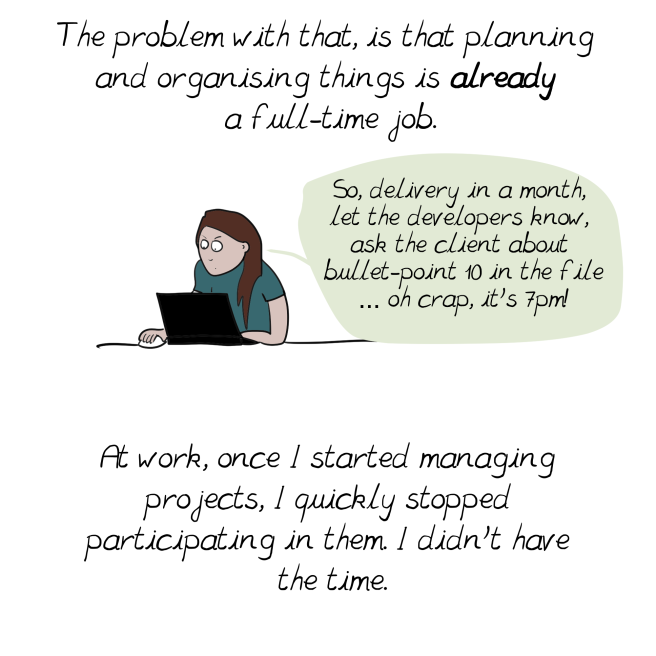
The problem with that, is that planning and organising things is already a full-time job.
Scene: Narrator at her desk: “So, delivery in a month, let the developers know, ask the client about bullet-point 10 in the file… oh crap, it’s 7pm !”
At work, once I started managing projects, I quicly stopped participating in them. I didn’t have the time.
So when we ask women to take on this task of organisation, and at the same time to execute a large portion, i nthe end it represents 75% of the work.
Woman in front of dirty dishes: “You didn’t do the dishes ?”
Blue bubble from off-frame: Well you never asked !
Feminists call this work the **mental load**.
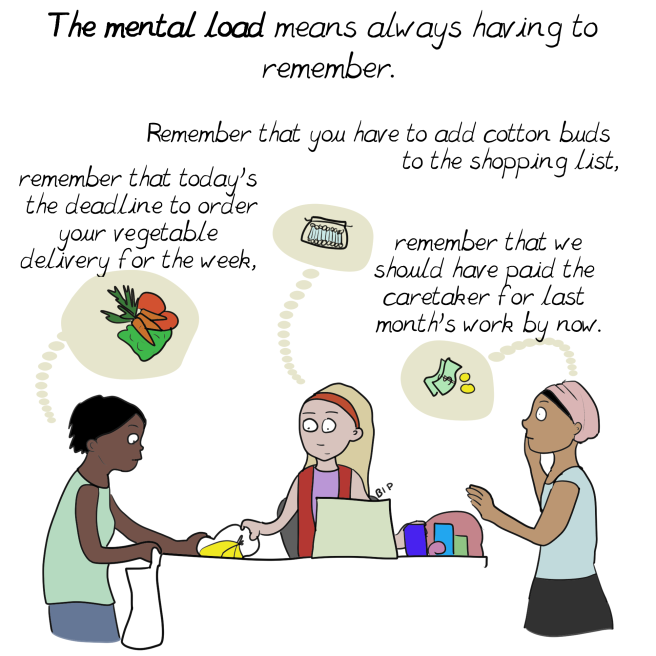
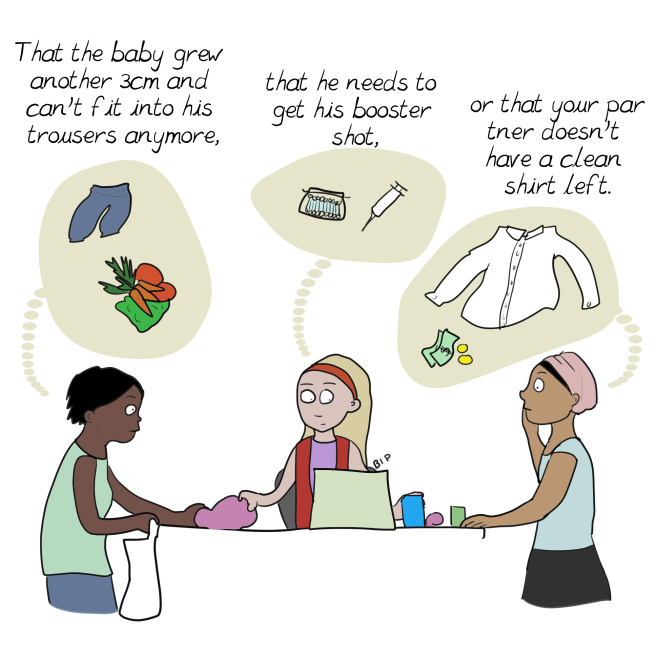
The **mental load** means always having to remember. Remember that you have to add cotton bud to the shopping list, remember that today’s the deadline to order your vegetable delivery for the week, remember that we should have paid the caretaker for last month’s work by now.
*illustration of women thinking such things while at a supermarket’s checkout, materialized by thought bubbles with drawings in them.*
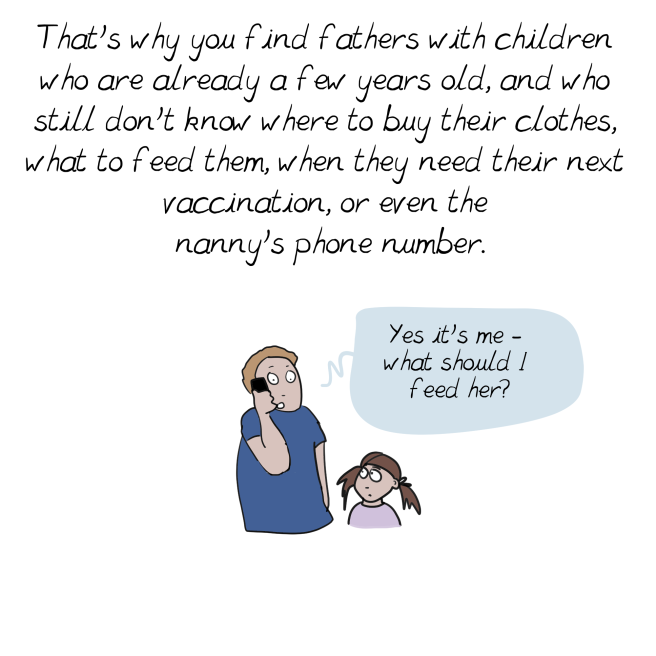
That the baby grew another 3cm and can’t fit into his trousers anymore, that he needs to get his booster shot, or that your partner doesn’t have a clean shirt left.
*the thoughts bubbles get more crowded*
The mental load is almost completely borne by women.
*A heterosexual couple in front of a TV, snuggled on a couch. The woman still has a crowded thought bubble, faded into the background.*
It’s permanent and exhausting work. And it’s invisible.
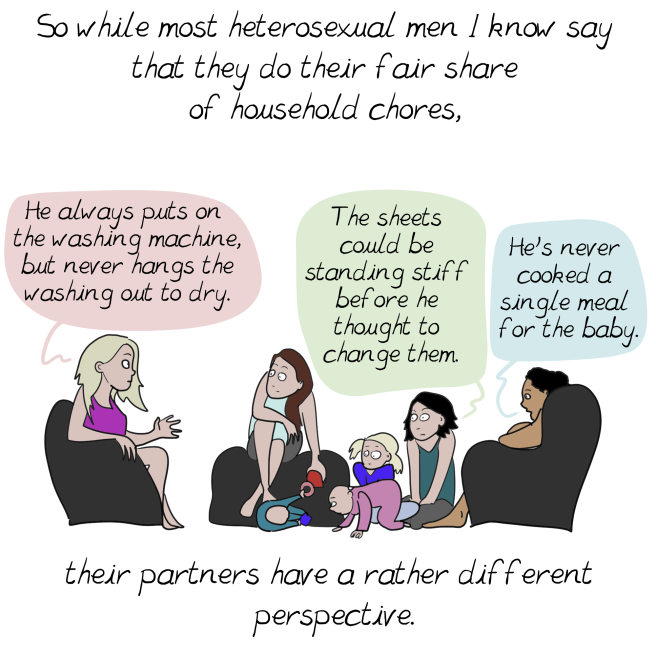
So while heterosexual men I know say that they do their fair share of household chores,
*Scene: Four women including the narrator on arm chairs, one kid and two babies in the middle, the narrator plays with a baby.*
Left woman: He always puts on the washing machine, but never hangs the washing out to dry.
Center woman: The sheets could be standing stiff before he thought to change them.
Right woman: He’s never cooked a single meal for the baby.
E*nd scene.*
Their partners have a rather different perspective.
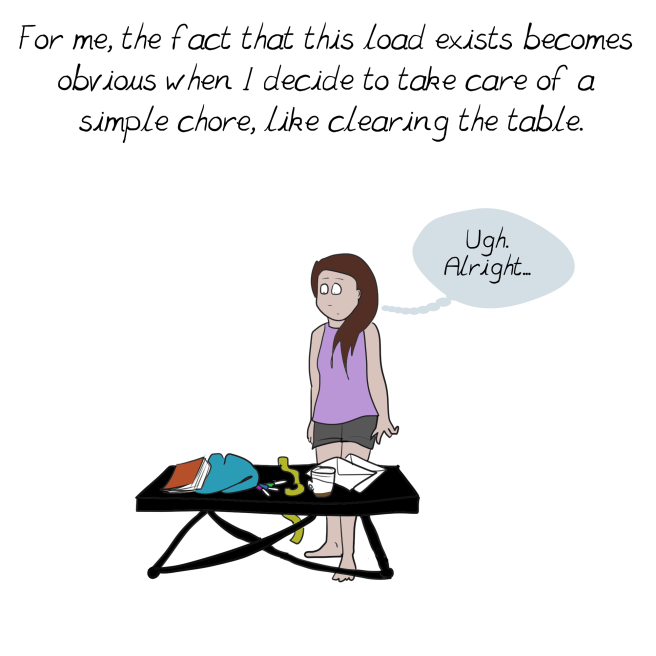
For me, the fact that this load exists becomes obvious when I decide to take care of a simple chore, like clearing the table.
Scene: narrator in front of a messy table, saying “Ugh. Alright…”
I start by picking something up to put it away, but on the way I come across a dirty towel that I go put in the laundry basket, which I find full, So I go to the washing machine… …and I see the vegetables that I need to put in the fridge. As I’m putting away the vegetables, I realise that I need to add mustard to the shopping list. (matching illustrations of the narrator tidying up)
And so on and so forth. In the end, I’ll have cleared away my table after 2 long hours.
*Illustration of the exhausted narrator sitting on a couch in front of a clean table.*
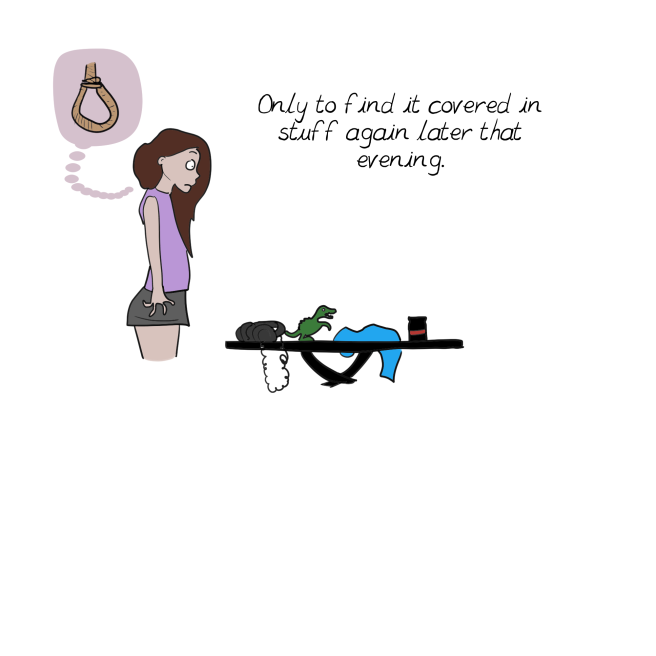
Only to find it covered in stuff again later that evening.
*Illustration of the narrator standing in front of a messy table, irritated and with a thought bubble picturing a rope hanged with a knot as to say “I want to hang myself”.*
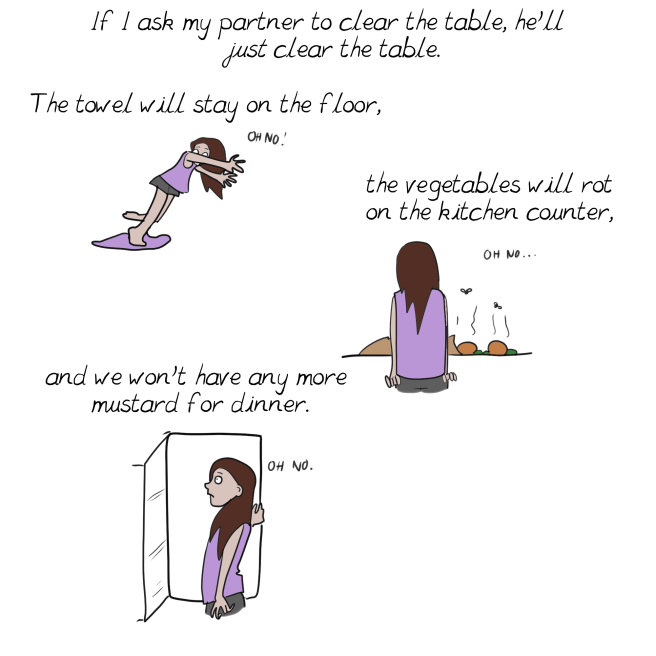
If I ask my partner to clear the table, he’ll just clear the table. The towel will stay on the floor,
*illustration of the narrator tripping on the towel: Oh no !*
The vegetables will rot on the kitchen counter (matching illustration: Oh no…),
and we won’t have any more mustard for dinner (narrator opening a fridge: Oh no.)
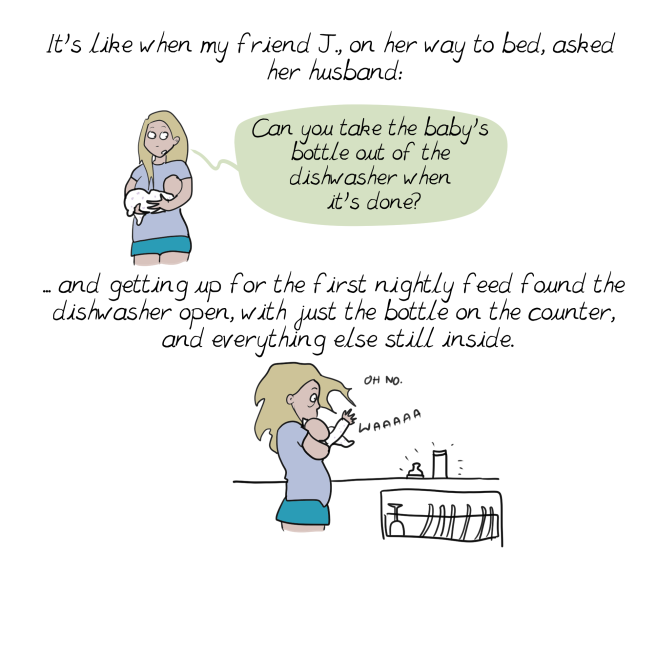
It’s like when my friend J, on her way to bed, asked her husband: Can you take the baby’s bottle out of the dishwasher when it’s done ?
…and getting up for the first nightly feed found the dishwasher open, with just the bottle on the counter and everything else still inside
What our partners are really saying, when they ask us to tell the mwhat needs to be done, is that they **refuse t otake on their share of the mental load**
Scene: One woman with arms full of laundry, walking and looking unhappy. One man in an armchair, with legs crossed and a laptop on his laps, saying: “Let me know if you need help.”
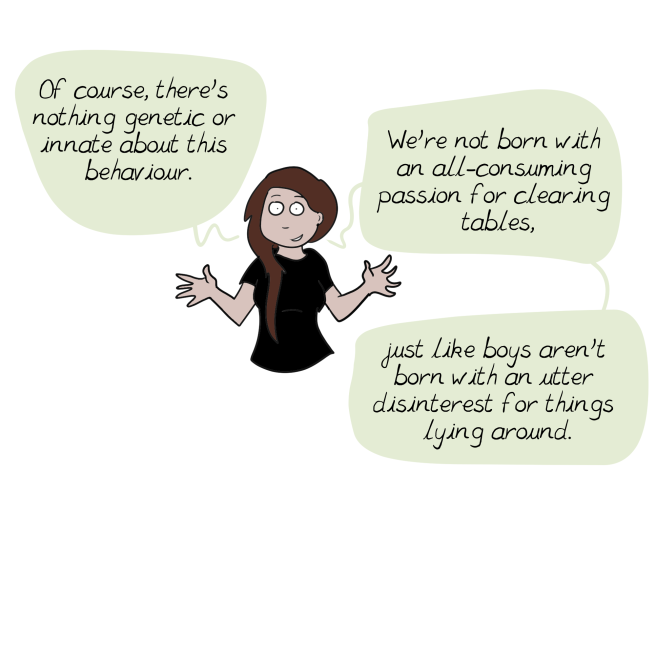
Of course, there’s nothing genetic or innate about this behaviour. We’re not born with an all-consuming passion for clearing tables, just like boys aren’t born with an utter disinterest for things laying around.
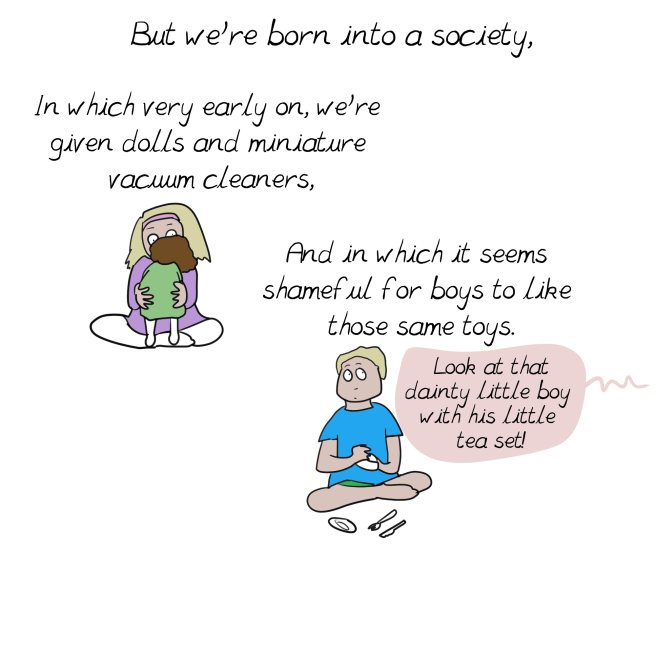
But we’re born into a society,
In which very early on, we’re given dolls and minitature vacuum cleaners, and in which it seems shameful for boys to
like the same toys
*illustration: A girl with a doll. A boy with a tea set. A voice from out of the frame: “Look at that dainty little boy with his little tea set !*
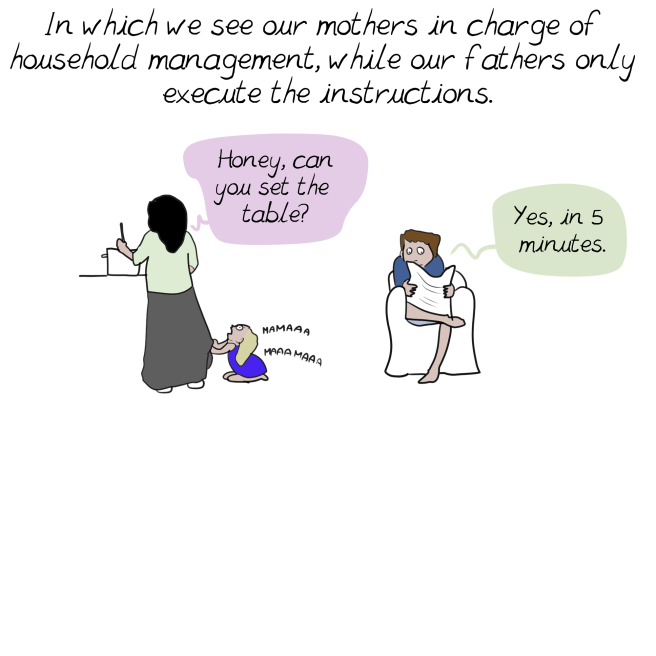
In which we see our mothers in charge of household management, while our fathers only execute the instructions.
Scene: Woman cooking, with a kid at her feet yelling: “Honey, can you set the table ?”
Man in an arm-chair, reading the newspaper, legs crossed: “Yes, in 5 minutes.”
And in which culture and media essentially portray women as mothers and wives, while men are heroes who go on fascinating adventures away from home.
Scene: Pregnant woman, holding a toddler’s hand on a doorstep: “Goodbye my love!”
Guy heading out in adventurer’s clothes with a quiver and a label:”Off to save the world”
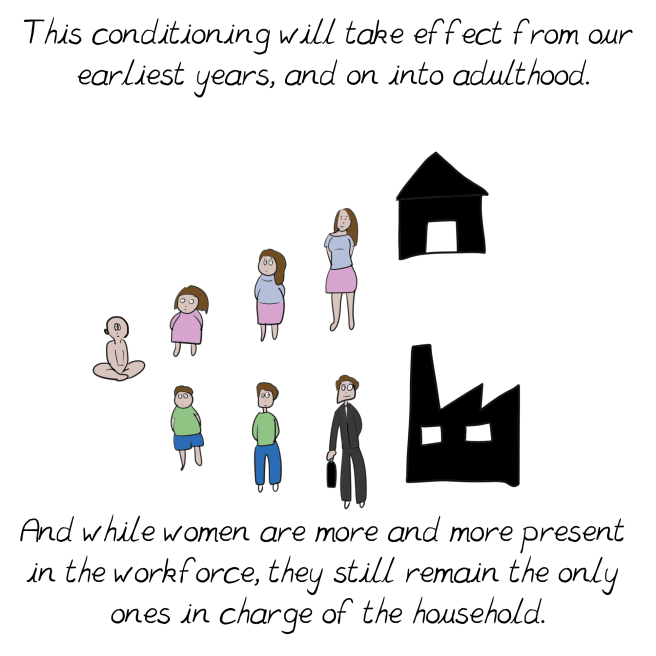
This conditioning will take effect from out earliest years, and into adulthood.
*Illustration: a baby becomes either a little girl, then a girl, then a woman, leading to a house shadow. The same baby in another direction becomes a little boy, a boy, a man, leading to a factory shadow.*
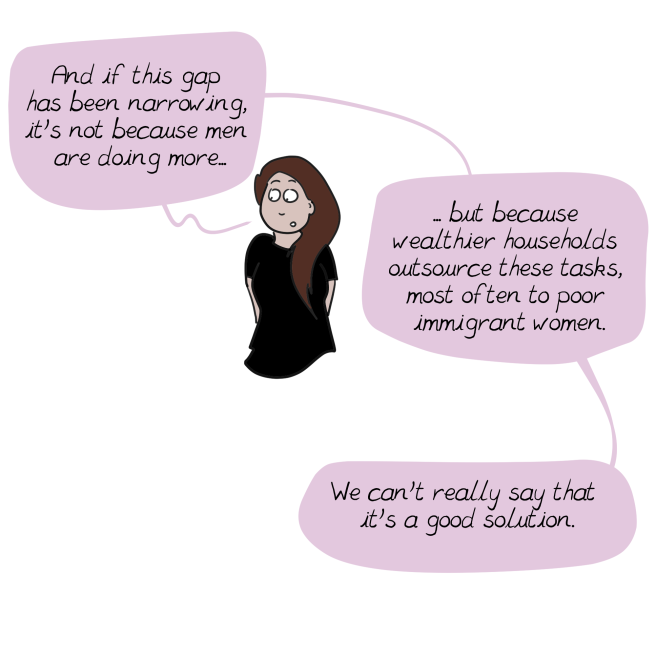
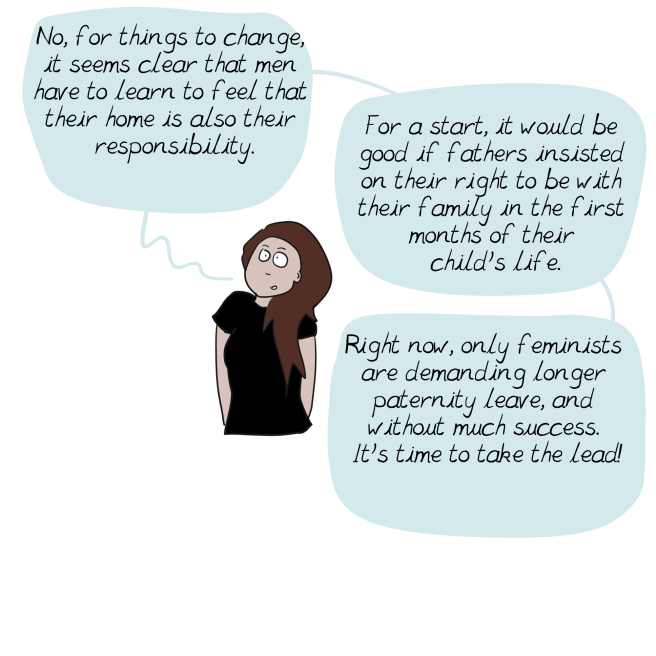
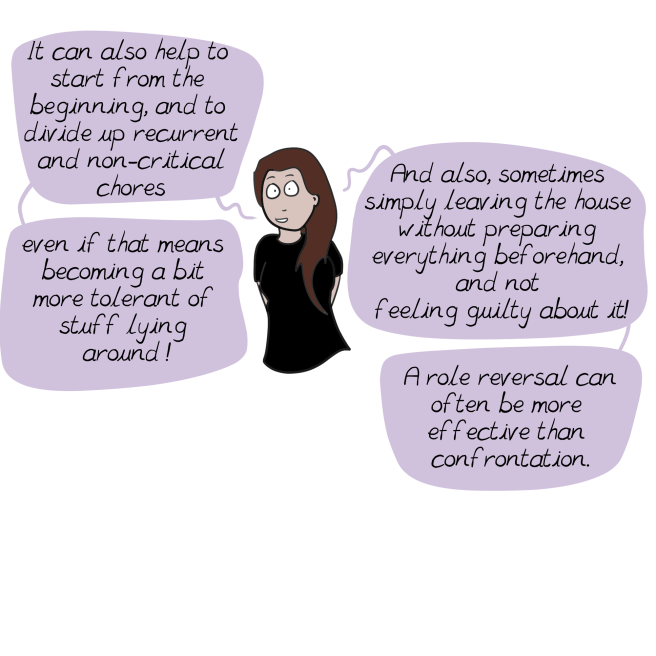
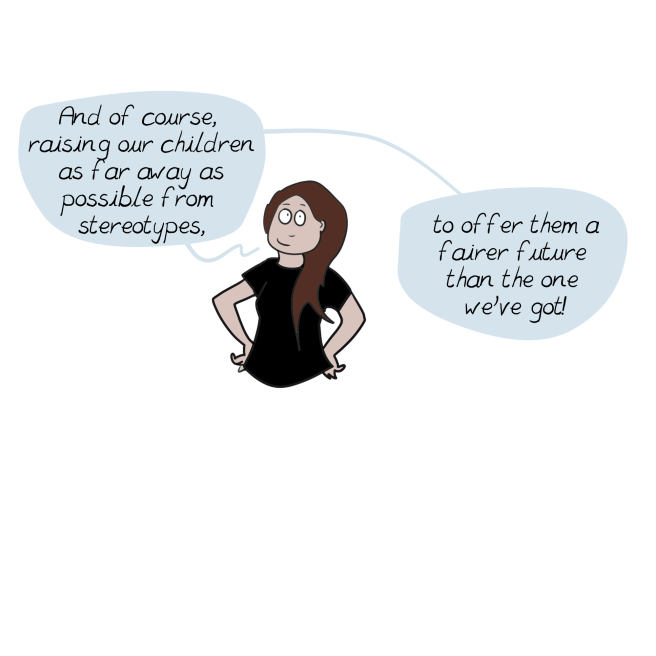
And while women are more and more present in the workforce, they still remain the only ones in charge of the household.
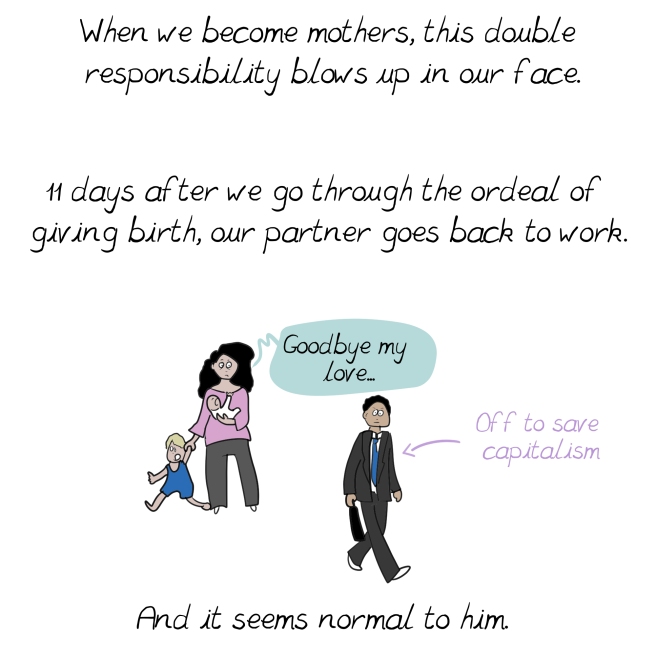
When we become mothers, this double responsibility blows up in our face.
11 days after we go through the ordeal of giving birth, our partners goes back to work.
Scene: Another pregnant woman, holding a toddler’s hand: “Goodbye my love!”
Guy heading out in a suit and a label:”Off to save capitalism”
And it seems normal to him.
During this time, while recovering from our stitches in between two sleepless nights, we’ll be thinking about everything that concerns the ba by.
Choosing a nanny… …buying clothes… …medical check-ups… …preparing meals. (matching illustrations)
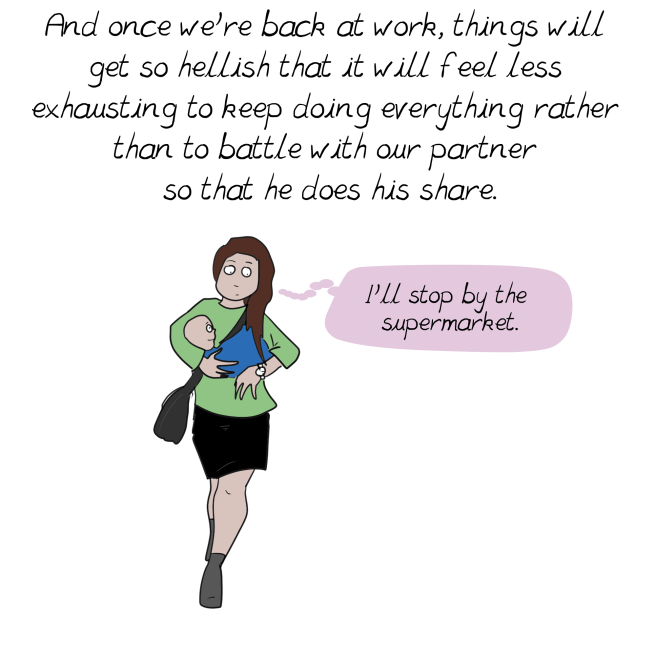
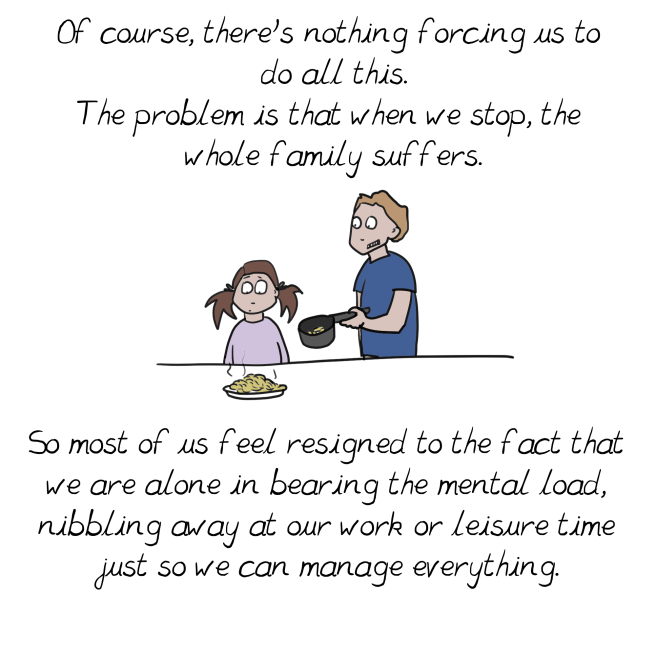
And once we’re back at work, things will get so hellish that it will feel less exhausting to keep doing everything rather than to battle with our partner so that he does his share.
*Scene: Woman carrying a bag and a baby, hurrying and looking at her watch, thinking: “I’ll stop by the supermarket”*
That’s why you find fathers with children who are already a few years old, and who still don’t know where to buy their clothes, what to feed them, when they need their next vaccination, or even the nanny’s phone number.
*Scene: Father on the phone, next to a girl: “Yes it’s me – what should I feed her?”*
Of course, there’s nothing forcing us to do all this. The problem is that when we stop, the whole family suffers.
*Scene: The daughter is now in front of a table, with a plate covered in some kind of hot mush. She looks circumspect. The father gives a tense smile, he holds the pan of mush.*
So most of us feel resigned to the fact that we are alone in bearing the mental load, nibbling away at our work or leisure time just so we can manage everything.
Scene:
Narrator: So. I already know what some people are gonna say:
Reader: It’s not true, I take care of half the chores at home.
Narrator: In that case, just as well ! (but try and confirm it with your partner). If things are like that in your home, it still doesn’t change the problem: statistically, women are still the ones managing household tasks. According to the French Institute of Statistics, women are still devoting 25 times more hours to chores than men.
And if this gap has been narrowing, it’s not because men are doing more… …but because wealthier household soutsource these tasks, most often to poor immigrant women. We can’t really say that it’s a good solution.
No, for things to change, it seems clear that men have to learn to feel that their home is also their responsibility. For a start, it would be good if fathers insisted on their right to be with their family on the first months of their child’s life. Right now, only feminists a re demanding longer paternity leave, and without much success. It’s time to take the lead !
It can also help to start from the beginning, and to divide up recurrent and non-critical chores even if that means becoming a bit more tolerant of stuff lying around ! And also, sometimes simply leaving the house withour preparing everything beforehand, and not feeling guilty about it ! A role reversal can often be more effective than confrontation.
And of course, raising our children as far away as possible from stereotypes, to offer them a fairer future than the one we’ve got !
Alright, I could say a lot more, but I’ll stop for today. In a future comic, I’ll talk about emotional work, which also gets heaped onto women. Until then, take care !
– Emma
LikeLike
And the inevitable defensive “not all men!” comments when it was made very clear in the strip that this is a *generalization.* Ugh.
Thank you, this is wonderful.
LikeLike
Passive aggressively posting this to Facebook so my partner reads it…
LikeLike
First read I completely agreed. Second read I realised that there was more too it (reading the angry male comments helped too- couldn’t disagree more with some of them but it made me stop and think).
My husband is actually the one thinking about the cleaning more than I do. In our house the only mental load I take on is the cooking (and packing if we are going away.)
But when we first got married one of our biggest arguments was over him ignoring the oven timer going off. I couldn’t understand that when he said he wouldn’t know if frozen pizza was cooked or not that he meant it and was actually starting to feel panicky. (We also had a guest over n he didn’t want to look stupid).
He pointed out cooking is the only area I take the mental load and I realised he is right. I need to be careful how defensive I am- this cartoon portrays my parents relationship and what I fear about relationships but it doesn’t portray my current experience.
He takes on the mental load about the car and any home improvements too, so when I stop to think about it, we’re pretty evenly spread and I should be grateful. But I feel like I am in a lucky minority.
LikeLike
Popping by to say how brilliant this is. Granted, I’m a full-time mom so it literally *is* my job to manage our household, but the questions of how that mental load is distributed, and how the emotional labor of caretaking and affirmation and all that is distributed, are still really important to ask because it’s so easy to fall into patterns where non-reciprocity is normal.
LikeLike
Reblogged this on wakey wakey, eggs and bakey! and commented:
Oh, bless. I like to think we’ve avoided the worst of these kinds of pitfalls, but it would be so, so easy to slip into them, unthinking.
LikeLike
Outsourcing can be a GREAT option.
LikeLike
I can’t wait to read your follow up on emotional load. At our house my husband works part time, I work full time and I feel like we share the mental load. However, I suspect he feels like he does it all and doesn’t realize that I’m still making sure little people’s toenails get clipped and clothes fit among many other things. Even though he does a lot I still have a hard time not being angry about the whole thing because there is so little recognition of what the full load actually is.
LikeLike
Amen to this! “Mental workload” so glad to know now what it’s called and why I have so many days where I am so busy yet don’t feel like I accomplish nearly enough.
She could’ve made one more little cartoon – – the one where the male partner says,
“We really need to (do/ get/ make/ fix) X!”
I did point out years ago to my husband that when he says “we need to” what he’s actually saying is “you need to”. Fortunately he acknowledged. the truth of it and has a sense of humor. He still does it, but he’ll make finger quotes as he says “we”.
LikeLike
I recommend this book: Augustus Y. Napier: The fragile bond
The author has some similar stories with some ways to make a solution.
In some families in men and women manage different ‘aspects’ of the houshold. They choose who would be responsible for each of the different tasks (cleaning, food, clothes, technical maintenance, utilities, bills, etc. ), or the same tasks at different times.
LikeLike
wow I really enjoyed this. Thank you. it really put into words (and illustration) something I’ve had trouble explaining.
LikeLike
I’m a stay at home dad and do the bulk of the shopping, cleaning, childcare, and everything else. When this comes up, women tell me it isn’t fair to expect my wife to do anything since she’s the one who works. Nice double standard. It’s about time for the next wave of feminism to come along, this one is sexist.
LikeLike
You haven’t taken into account that women are naturally more capable of multi tasking. That’s just a fact.
And then there’s the lawn, the shrubs, the trash, the oil, the, maintenance of two cars, the trash, the recycle, the pool, the pool filter, draining the pool, buying the fertilizer, spreading the fertilizer, trimming the hedges, tending the weeds, getting the mail, fixing the spouts, etc I do none of this. It’s a trade off. They are not lazy just need clarity and direction.
Peace.
LikeLike
I think the fact that you know all of those things need to be done at all is a clear indication that this is still a problem. In most scenarios like the one in this article, the man doesn’t have any idea what the woman is even doing with her time. In my case, my husband doesn’t do *any* of those things because we outsource pretty much all of those tasks (that are applicable).
If you feel that you are truly in a 50/50 relationship, that’s great. You’re the extreme minority. However, the fact that you think adult men should need direction and clarity from you to perform tasks is pretty telling. I don’t feel it’s my job to supply my adult husband with clarity and direction. He’s been an adult for more than 25 years. He shouldn’t need my help figuring out what adults need to do.
LikeLike
It’s sad that these boys are being called men. boys who’ve had mommy pick up after them and never learned to be independent men who care for themselves and others. actual men don’t need to be asked; we do what needs doing. We support our loved ones because we love them. We pick up their socks when they’re exhausted, we make dinner. I am so sad that all these large boys are being called “men.”
LikeLike
Reblogged this on DestinMom.
LikeLike
On the flip side I would say that if the guy does anything he does it “wrong” all the time i.e. Not the way the woman would do it.
That constant “you’re doing it wrong” is disempowering. When baby doesn’t settle for the guy it’s something he’s done wrong but if the baby doesn’t settle for the woman it’s something wrong with the baby.
So while I generally agree with the comic I think there is that flip side where men are made to feel they can’t do anything right.
LikeLike
In most cases, there is a clear right and wrong way to do something. Even if it’s just a preference, chances are the preference has been clearly stated several times. The, “if you want me to do it, I’m going to do it my way even if it’s wrong” excuse is very tired. A man couldn’t get away with that at work so why would be assume he should get away with it when his family is concerned? Are they really not worth his attention to detail and dedication?
LikeLike
I am a little guilty of this. But my wife is a little guilty of retaining control. Let go of a few things, allow for different standards (within reasonable acceptability of course), and give us a few iterations to get it right.
LikeLike
I used to take on the mental load. Now my husband does it. It doesn’t work when both people share the management responsibilities. As we transitioned the responsibilities from me to him, we always made mistakes assuming the other person did it (packed bags, made lunch) or we repeated tasks (make appointments, etc.) Now, he basically takes on the house mental load and I take on the kids’ school mental load. Although, after reading this cartoon I’m reminded that I could do a lot more around the house to help him.
LikeLike
When was this written? 1957? This is a huge generalization about how ‘most’ households run. Thank God I found a better man than those you portray and commenters complain about. I didn’t know those men still exist.
LikeLike
Emma thanks. I am so grateful for the work of Paul And Stacey Martino. In their on line course called The Breakthrough Course, they have combined the work of many many relationship experts that came before them, to teach me some of the skills i need to make my next relationship fulfilling. I used to be more of a pure feminist lol. Not really there anymore except for key issues like a woman’s right to choose, and women should get paid the same at work for the same job.
In this post you are scorekeeping. You will never win and you will always feel like you are doing more, and you will always judge your partner by your own expectations and “standards” of what he should be doing and you will always be disappointed. He should think like you and anticipate your needs and take on all your stuff.
Whether you are a stay at home mom or you work full time you will always be disappointed if you score keep and cant see the contributions of your partner (they are sometimes hidden from women’s understanding- and totally awesome). Of course asking for help is totally fine!
And giving your partner and children regular stuff to do, and outsourcing what you can, and asking older kids to help, and filling up your own needs buckets when your partner cant always do this.
And saying no to stuff. All fine. Finding the ways your partner contributes, (many ways, again, not really obvious to most women) will bring more satisfaction in the relationship.
scorekeeping = misery
LikeLike
thank you! i have been a mom for almost 12 years now & am completely exhausted. my moments of insomnia every night are spent planning & working out solutions to problems for our family. the dad doesn’t believe me when i tell him being a mom is a 24/7 job (without pay or benefits.) even when i appear to be resting, i am working.
LikeLike
Because Emma got it SO RIGHT for the most part, I feel the need to address the one small piece where I believe she got it wrong:
“because wealthier households outsource these tasks, often to poor immigrant women. We can’t really say that it’s a good solution.”
While I can see that this line of thinking is coming from a good place, it strikes me as yet another example of more privileged feminists ignoring the reality for women living under different circumstances while patting themselves on the back for considering “poor immigrants” at all.
As a cleaning person, I take issue with the notion that my job should become obsolete in a better, more equal society. Domestic work is not shameful, it is a viable career choice for many and should be viewed in the same light as any other contract work such as landscaping, carpentry, roofing etc. (and compensated in a similar manner). The idea that domestic workers are inherently “less than” other skilled laborers is rooted in the same type of casual sexism the rest of this comic is fighting against.
LikeLike
Hi, I’m sorry if that part seemed disrespectful for persons whose job is house cleaning.
I don’t think it’s a problem to outsource house cleaning, I think it’s a problem to outsource it to a badly paid person so that “privileged” women can go to work for a better wage than the person who cleans. This is exploitation ; and I don’t mean it like women who do this are mean persons or something, they do what they can to enhance their situation and it’s normal. It is just not a solution to solve gender domination by relying on economical and/or racial domination.
So I don’t think that cleaning jobs would become obsolete in a better world, I think that when some person will do this that’s because their are good at it, not because they desperately need money to survive, and they will do it for the same wage as anybody else.
Sorry again if I didn’t make this clear enough in my comic. I think housework is key work and should be so much more promoted.
LikeLike
Love this! Thank you thank you thank you! I’m looking forward to your comic on emotional work. Best wishes with that!
LikeLike
Is there a way someone can obtain a printed copy of this to frame or keep as a bound keepsake? It’s a conversation my partner and I have often and it would express my appreciation for her struggle.
LikeLike
I seriously could cry right now. I didn’t know how to describe this to myself, much less to my husband.
Why do I need to ask him to load the dishwasher and then literally tell him every dish that needs to go in it? How is that helpful to me? Why don’t you know where clean dishes go?
I just can’t even….
LikeLike
My DH and I have been fairly egalitarian about many things throughout our 25 years of marriage. We renegotiate some responsibilities as our life circumstances (commute times; age of kids) change. One recent development: an agreement to be not only responsible for cooking a meal, but for taking on the mental burden of it. I personally found it to be a huge relief not to have to even think about dinner on my partner’s cooking nights. The trade off is that I don’t question his meal choices–which can range between fabulous from-scratch dishes and take-out pizza. Despite this recent epiphany, I didn’t really appreciate the whole mental burden concept until you illustrated it so brilliantly in this post. Thank you!
LikeLike
This page keeps re-loading at the top (or near the top) of the comic. I never get past the first 5 comics…very frustrating.
LikeLike
It’s a lively example of how female qualities are needed to run the household and caretaking, as much as the male qualities of taking care of earning and their part of being the male role model. It is something that has developed within our deep unconsciousness and instincts over the past thousand years. It can be viewed as Jin and Jang. Both sexes have qualities and they complement each other. It started already when the males were going out hunting for food and the females were staying at home taking care of everything. The female qualities here are (amongst others) managing, dealing with change and scarcity, caretaking, keeping oversight and the big picture, cleaning, preparing food, provide clothing, socializing and helping other females in need in the community. The male qualities here are (amongst others) hunting, goal oriented, focussed, leaving ‘unnecessary details’ behind (as this could be harmful for reaching the goal of the hunt), competitiveness, power, pride, showing of their achievements, conquering, fighting, risk seeking and innovativeness.
So in the article a male who is asked to clean the table, will clean the table (goal) and will leave other (unnecessary details, as a towel) things laying aroud. Afterwards probably bragging about the cleaned table… but that’s instinctive behaviour. (Not to make an excuse, but more searching for insight why women and men behave so differently). And we should not forget that all qualities come with a shadow.
Basically, it’s natural unconscious behaviour for women to take the ‘mental load’ for the household (and also at work, when women are working). Men obviously are programmed differently, so will naturally do things (as caretaking and household) in an other way than women would like them to do, just because they are men. (Again, not stigmatizing, but exploring male and female qualities!) Of course we can show gratefulness to the other more often…
What I’m trying to say is, men and women are different, we should embrace the qualities of both sexes and explore together the ‘gaps or lacks’ of the other one, and try to complement each other. Some patience and listening to the other will help. Hopefully developing together towards a balanced couple. We cannot do anything to the fact that we are all humans, born as male or female with our own (un-)conscious qualities. Happy life together!
LikeLike