
Here is the english version of my now famous “Fallait demander” ; now available as a book with other stories :

Orders available here or here or here ^_^
Thanks Una from unadtranslation.com for the translation 🙂

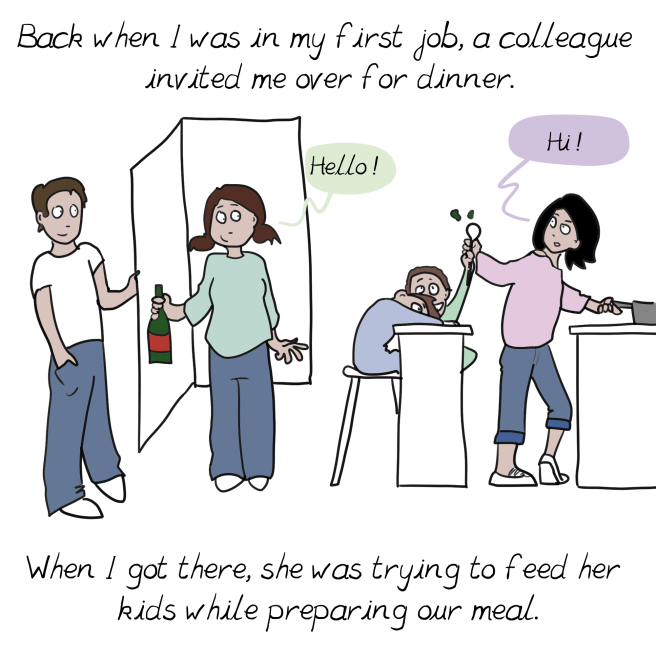
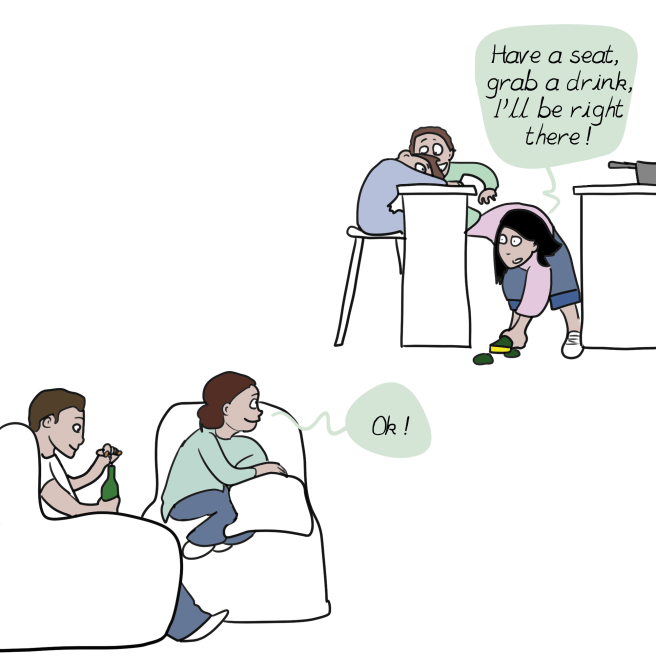
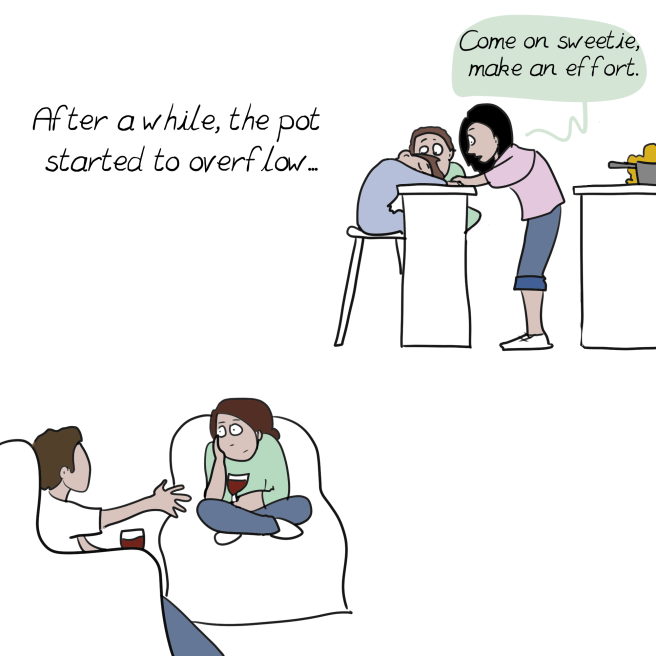
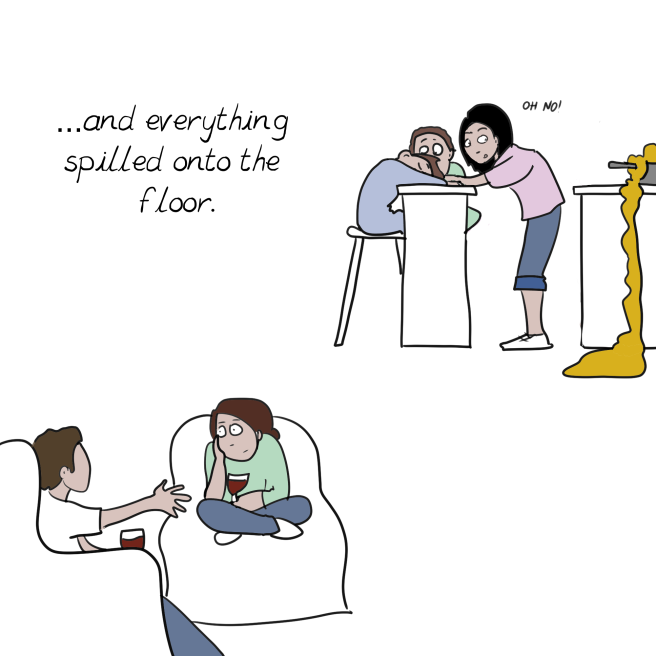
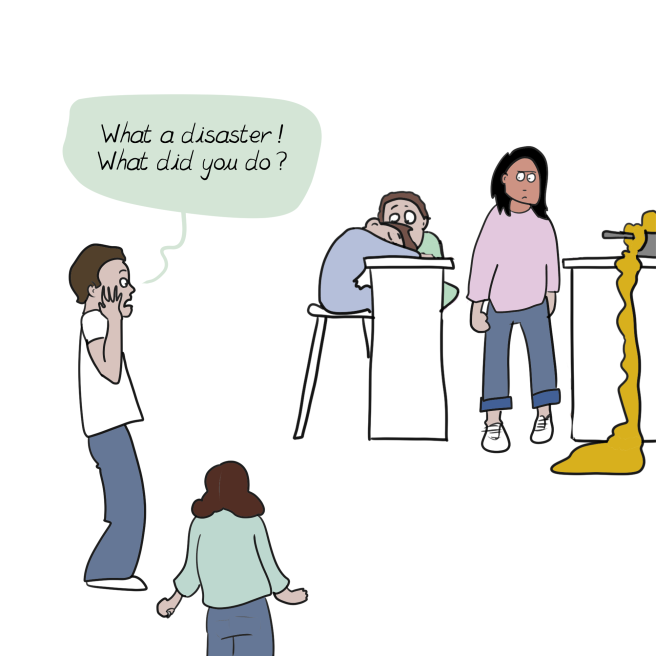
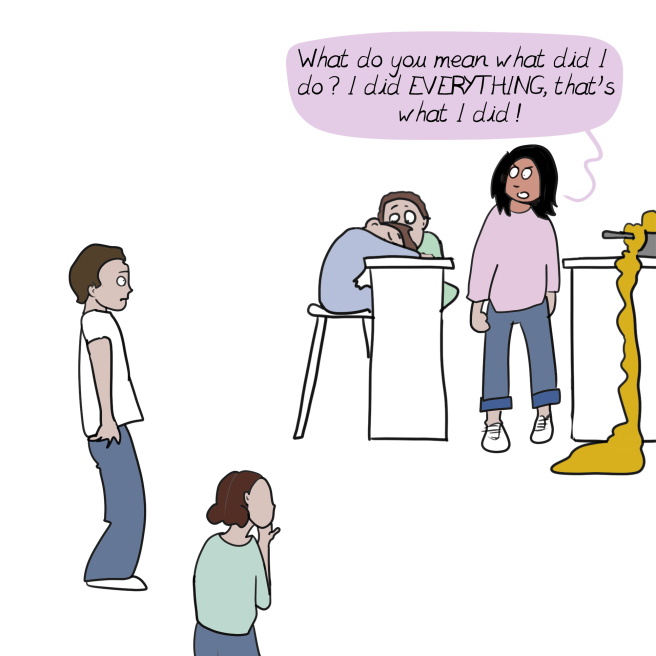
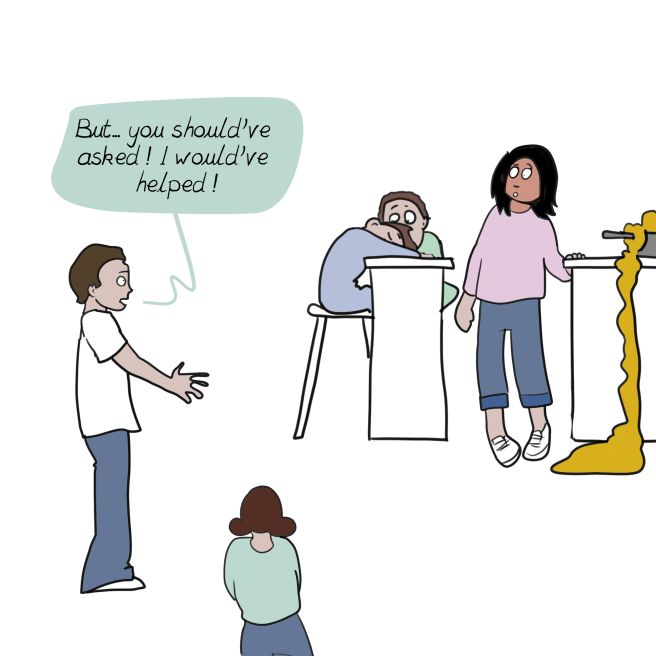

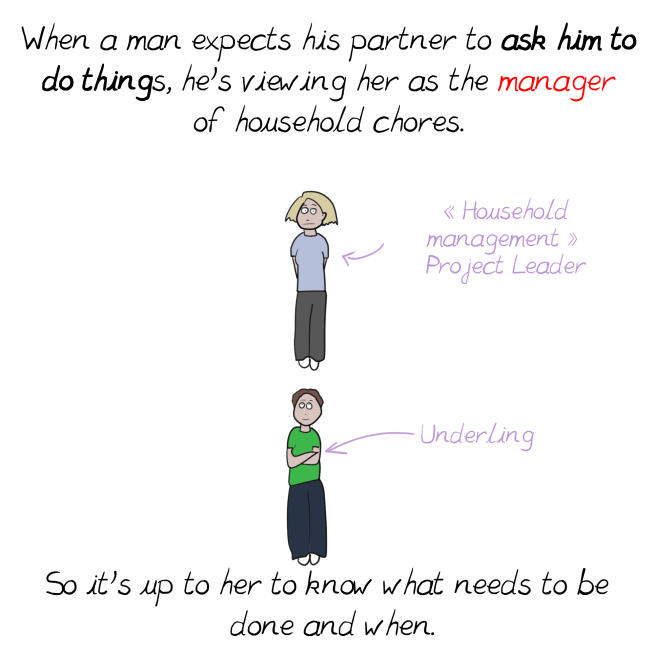
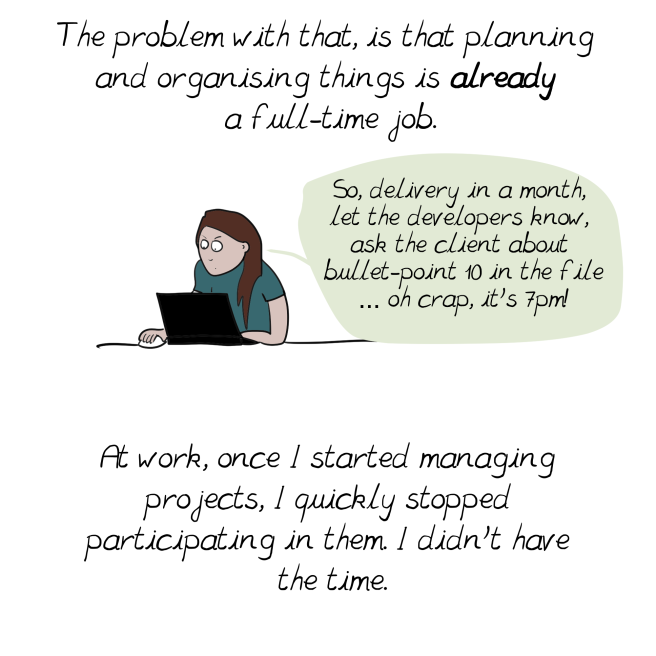

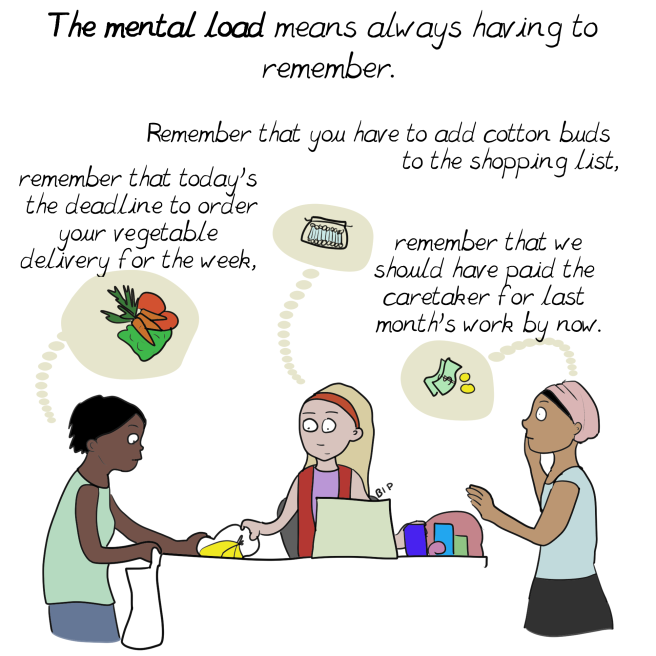
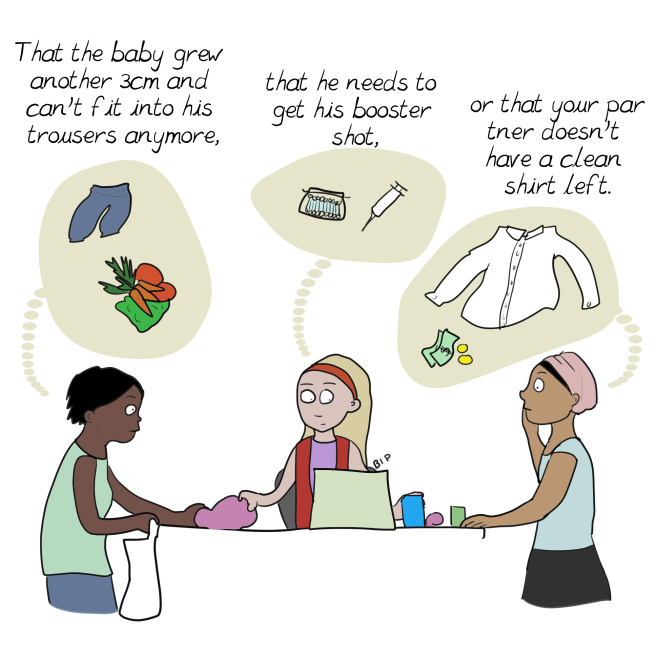

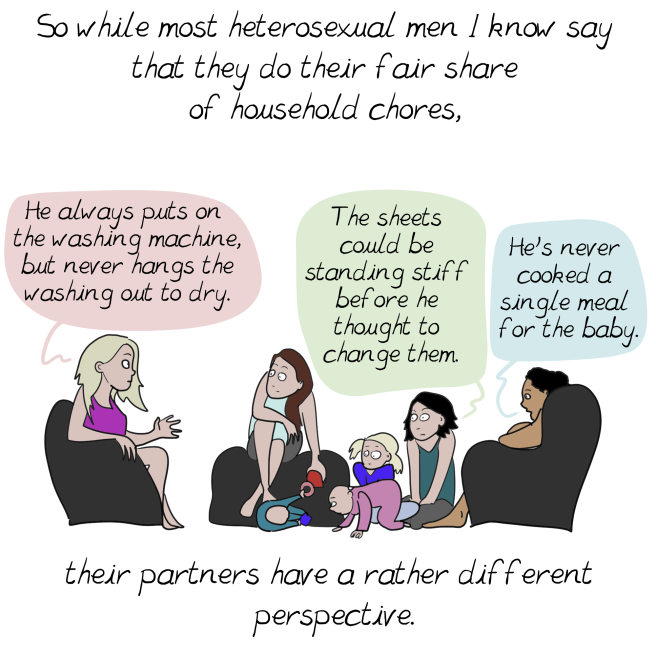
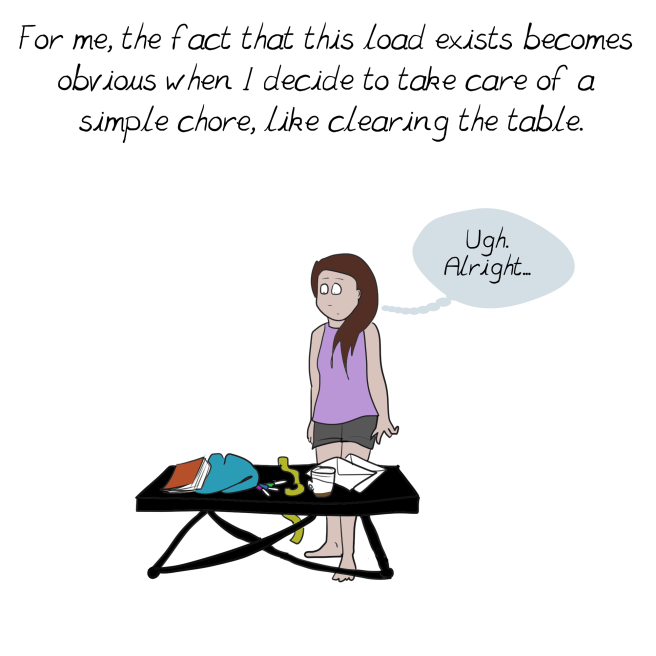


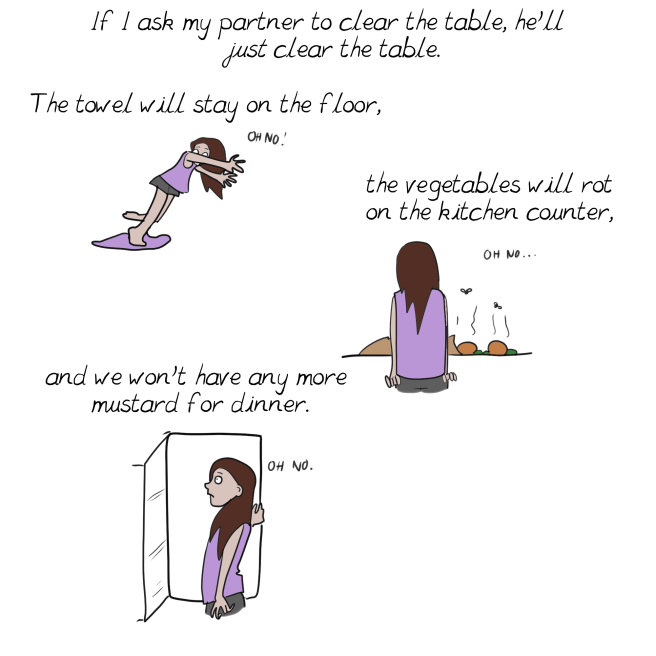
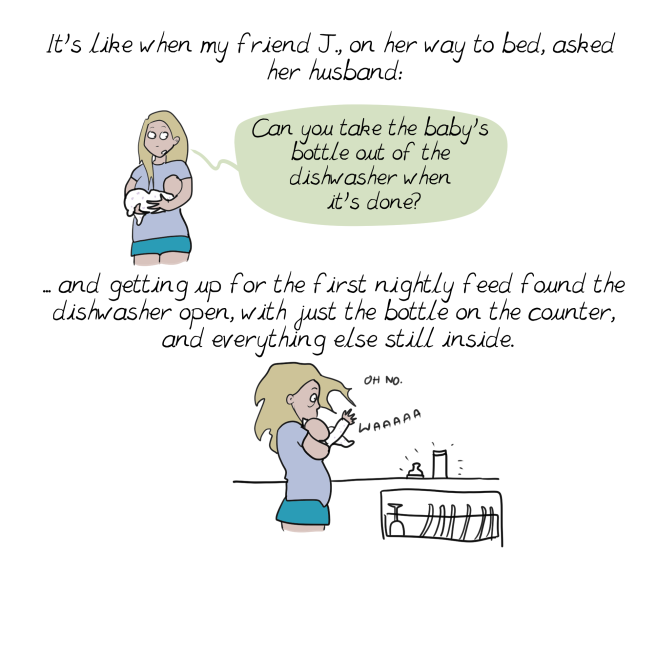

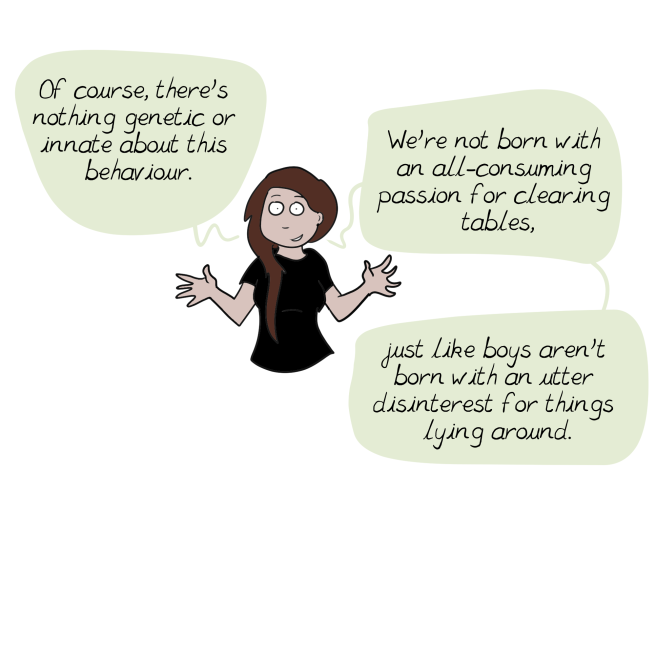
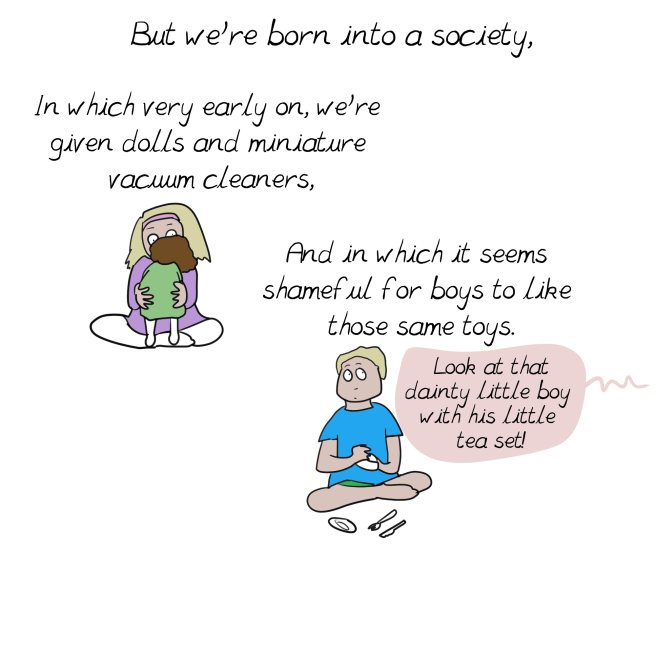
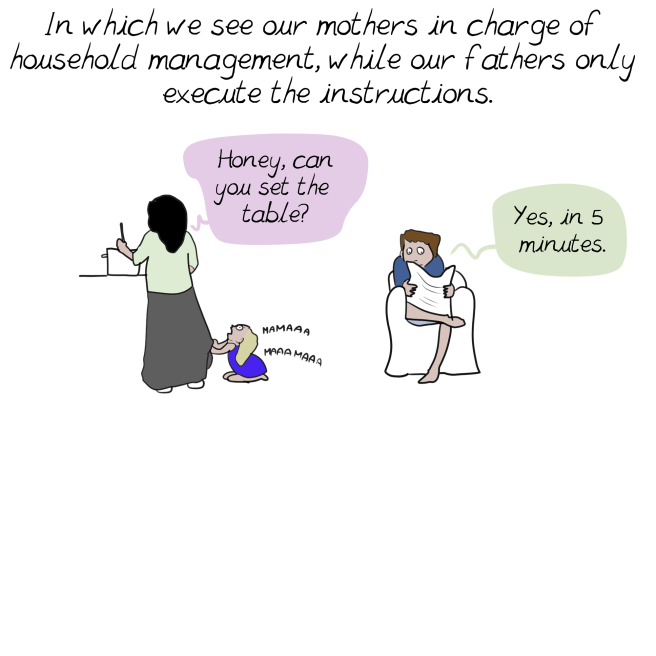

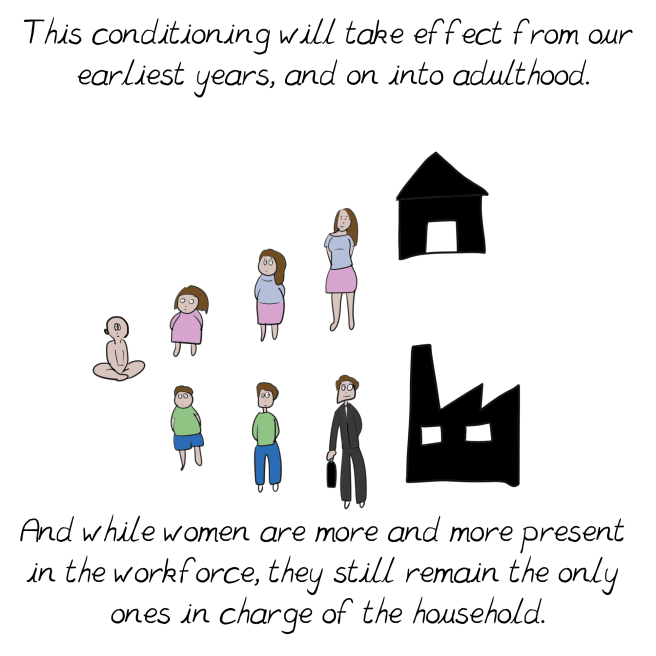

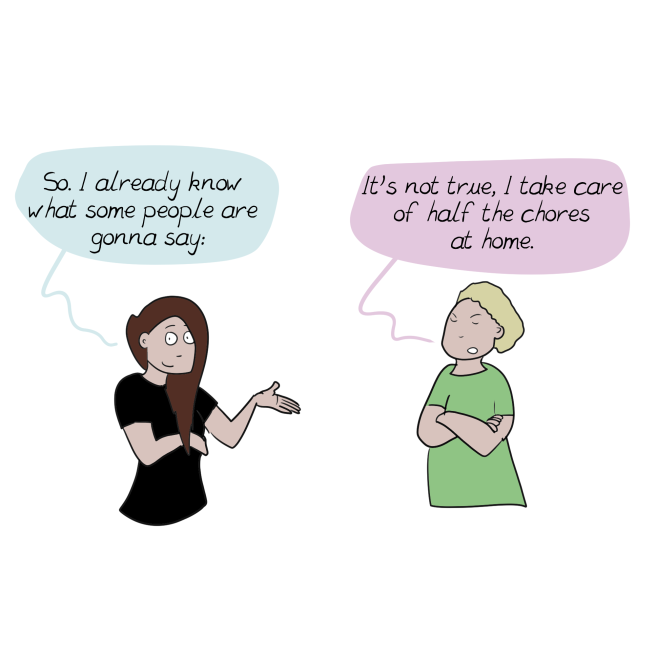
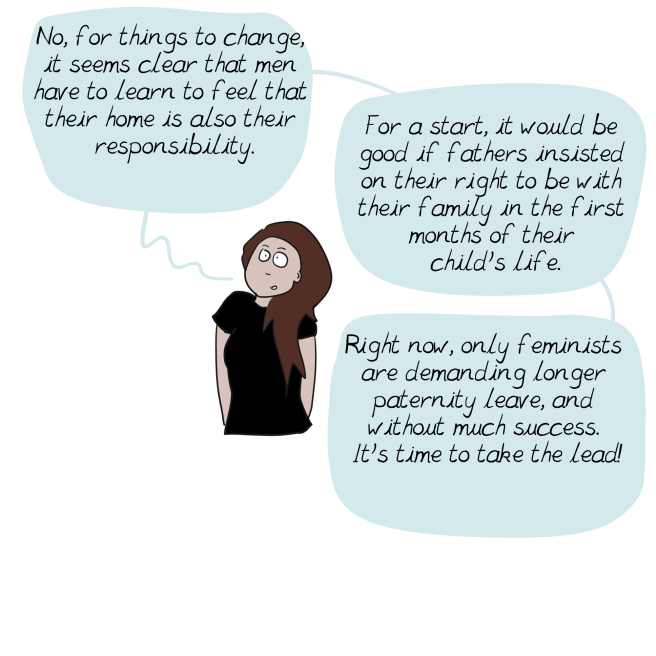
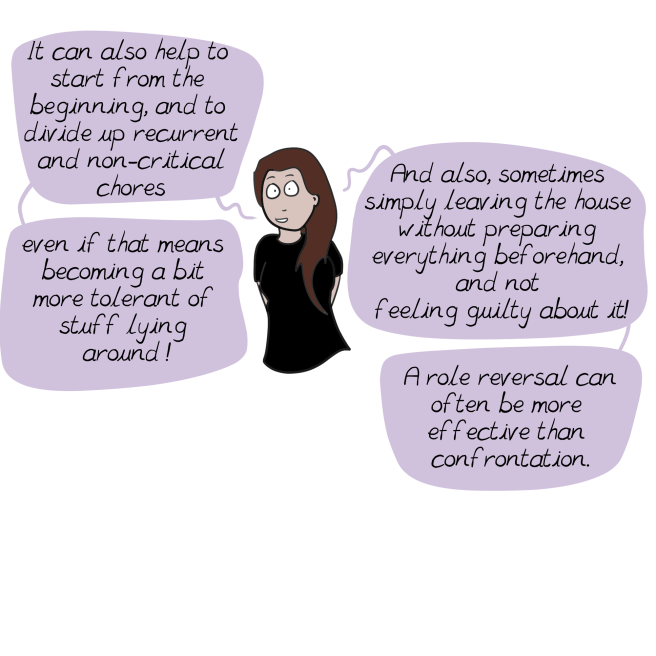
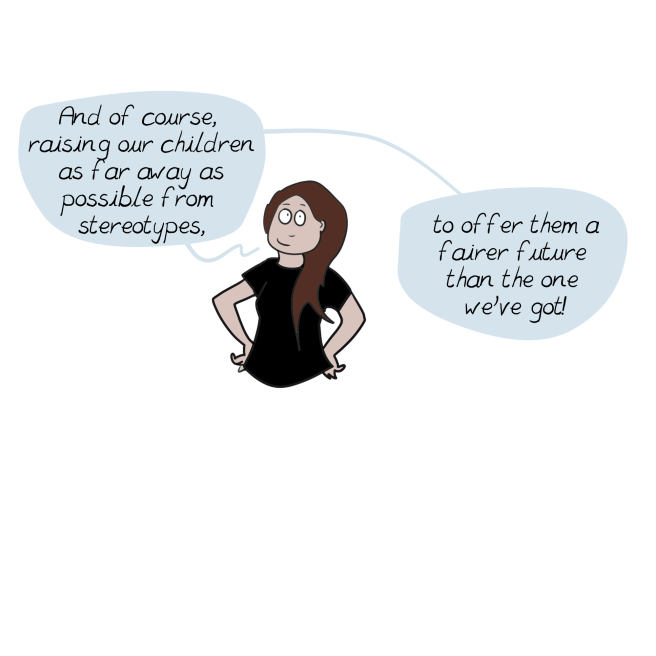
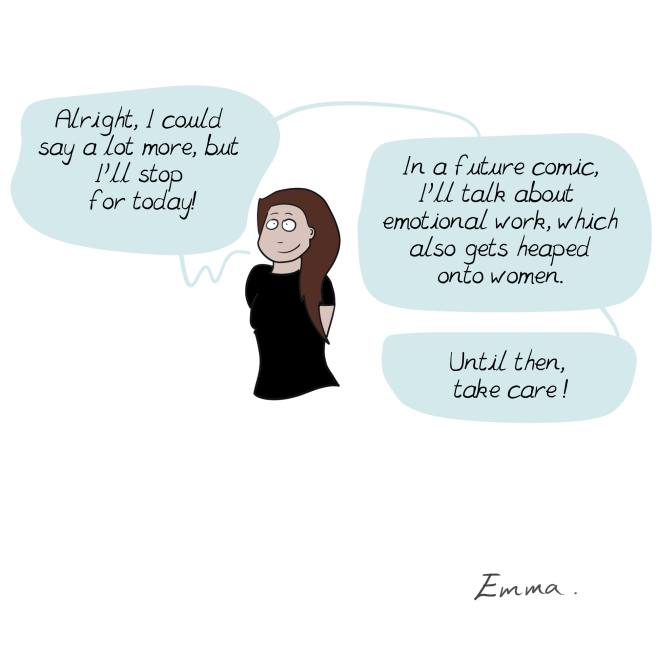

Here is the english version of my now famous “Fallait demander” ; now available as a book with other stories :
Orders available here or here or here ^_^
Thanks Una from unadtranslation.com for the translation 🙂
 Emma
Emma 
I guess I’m not a proper woman, because I don’t worry about any of this stuff. The only time that I care if the house is cluttered is when we have guests over, in order to avoid the judgement of other women. We both accidentally do things like start a load of laundry and then forget about it. And then when we remember that the shirt we wanted to wear is actually still in there, we grumble for a second, rewash the clothes, and find a new shirt to wear in the meantime. If you’re out of mustard, then use a different condiment, or run to the store real quick. I get so tired of seeing something that complains about how men make women’s life harder, and completely identifying with the man. I’m the person that takes things apart and then takes a month to put them back together. I’m the person that leaves my tools laying around. And somehow, life continues. Except I’m not constantly angry at my spouse for not caring about the same minutia that I do.
LikeLiked by 7 people
I understand how you feel, Debbie. I am the exact same way! In fact, my partner is the one who runs the household. We butt heads on some things, and our 8 year old has completely changed the way we view these problems. I tend to be the one who messes up the table because I work from home, and I know it gets on his nerves, but I find myself doing it all the time, ha.
I think that just because we don’t identify with this doesn’t make it any less valid though. I know my mother had to constantly bear this mental load every single day (with 6 children to take care of no less) and it was her reality. There’s a really pervasive problem in our society, and maybe it starts with the way mothers are raising their sons. The author makes some really good points that apply to so many women that should be acknowledged.
LikeLiked by 10 people
Yes, but you are the minority. Recognize the need for it to get better for the majority, as one day your kids or someone you care about may be part of that crowd (and likely are now)
LikeLike
Just because things don’t happen to us personally, that doesn’t mean that they don’t concern a huge part of the population. And just because you don’t feel oppressed or affected by patriarchy, that doesn’t mean oppression and patriarchy don’t exist. What you are doing with your misogynystic comment is dismissing a collective experience that occurs in and because of patriarchy by considering it to be nagging, which is a very convenient tool in this society often used against women and the problems they face in everyday life. It is like questioning the existence of sexism because you personally were never harassed.
LikeLiked by 1 person
It’s not quite the same. I wrote a long post below about this, but the problem with this article is that it only addresses one specific couple’d arrangement, when there are so many other ways partnerships operate today.
I personally don’t think sweeping generalizations do either side much good on these topics.
LikeLike
Of course, just because something happens or doesn’t happen to one doesn’t mean it’s the same for everyone else. But I find it ironic that this cartoon, which tells the story of many, but not all, in a manner suggesting is the same for all, is okie dokie, But if anyone gives an alternative story, they are somehow sweeping the issue under the rug. Other than raise my children to be involved in all parts of their marriage, which I’ve already done, I can’t really make anything change for anyone else. Unless you suggest we pass a law that corrects this issue, which would be ridiculous. If you need a change in how things are done in your household, make the change! If you won’t make the change in your home, stop complaining.
LikeLike
I took away something completely different from this post – the effort that goes into managing things (whether it’s a household, an office, or a team).
I’m not married, but my long-term boyfriend and I started a company together 2 years ago. I’ve worked as an office manager before and my current role is in accounting, so it naturally fell to me to manage the business. Of course I don’t mind doing it, but the lack of recognition from him is infuriating! Any manager knows that the hallmark of doing your job well is that nobody knows it’s been done. My boyfriend may think that things are divided evenly, but if I were to go into a coma for a week no one would have any idea what they were supposed to do that day or what supplies needed to be ordered, and they would exhaust themselves trying to wrap their heads around it.
I’m very happy that your household has reached a balance but I interpreted this post as trying to shed light on the fact that managing things is very real work. Since it’s a mental effort it tends to go unrecognized, but it’s there and it’s significant.
LikeLike
I agree with you Debbie, especially the bit about “Except I’m not constantly angry at my spouse for not caring about the same minutia that I do.” There is more to life than becoming obsessed by things that just don’t matter. If it’s that important then communicate, make a list of chores you expect him to do. But I really don’t like this type of gender defining. There are plenty of guys who are terrific at sharing the Mental Load.
LikeLiked by 1 person
I think this all changes when children are involved. Run to the store real quick… when you have a toddler and a nursing baby.. that doesn’t exist anymore for me. No eggs or milk means no easy breakfast, I can’t just pop out to the store, I have to do the mental work constantly to make sure it’s always there.
LikeLiked by 1 person
And you don’t call your partner and tell him he needs to bring home eggs and milk? Or hand him a shopping list and tell him it needs to be done by tomorrow? Or, better yet, tell him he’s the one responsible for grocery shopping from now on? And if he forgets those eggs and milk it’s oatmeal for you and the toddler and he can fend for himself. If you don’t want all the household responsibility, you can stop. You.
LikeLike
Guess you’re also not concerned if your spouse is as happy as you are as he is clearly bearing the “mental load” in your household.
LikeLike
Do you have kids? because based on your comment it seems like you don’t (and that’s fine, too). So you don’t identify with this commentary. Ok. No need to complain about it. For those of us who this really resonates with this was such a powerful conversation starter. There’s really no progress being made when women knock down other women simply because we don’t agree with one another. We are all in this together.
LikeLiked by 4 people
Actually, I’m failing to see what having kids has to do with this (maybe because I don’t have any :D) – you are either intent on having everything managed, or you aren’t; motherhood is definitely additional load, and can shift your perspective significantly, but doesn’t change anything about this basic truth. If you don’t want to have everything perfect, your life is just much more simple and pleasant.
Plus, there’s one good point mentioned by Debbie – she says she pays more attention to cleaning before visit is to arrive, just not to be judged by other women; and I can’t shake memories or how many times one of my friends said something like: please don’t look around, I hadn’t time to clean… please excuse the mess… which is absolutely absurd – I came to see her, not to count dirty socks on her floor or something 🙂 Why do have women ingrained this feeling they have to apologize for anything in their own home?
So, when you say we are all in this together, you’re right: and we can start to get out it by being more lenient and tolerant not just to ourselves, but to other women in our vicinity. Because I would wager my savings, that big deal of the pressure we women feel is created by our fellow women, and that’s rather sad, and pointless.
LikeLike
There is no “run to the store real quick” when you have small children and you are the only adult home with them.
LikeLike
Um, my husband is a commercial pilot and he’s gone days at a time, even a month sometimes. This was not easy when our children were small, but I managed to get my infant and 2 toddlers to the store when necessary, to church, to the post office…Those things needed to be done and I did it. Once he was gone for 6 months and I had my 3 plus 6 other children in my licensed home daycare. Somehow, even with 9 kids I was able to keep the house clean, us fed, laundry done, the yard and gardens taken care of, and so on. If you decide it can be done, it will be done.
LikeLike
Thanks for the comic. It helps me see some of my behaviors and understand the frustration of them.
LikeLiked by 3 people
Love this response so hard.
LikeLiked by 3 people
Me, too!
LikeLike
I am curious for all the (mainly) guys stating that you can only be told you’re doing something wrong so many times before your partner just takes it away: is that how you do things at work? How about when playing sports or doing schoolwork? If at work or school you’re doing something incorrectly, you get the correction over and over until you’re doing it correctly. Same with sports, arguing that you’re doing it fine your coach is just being a picky nag doesn’t get you far. You accept the direction of whomever is in charge. Whereas here it seems there is a lot of “it’s not wrong it is just different!” maybe you argue like that with your supervisors too. Maybe you all just have really vague unreasonable partners who just declare all tasks “wrong!” And refuse to provide any explanation, like they’re allergic to that laundry detergent or loading the dishwasher that way means the spoons don’t get clean or if you don’t food away you get pests. But I am doubtful.
LikeLiked by 6 people
Basically what you’re saying is that the woman is in charge, right? You’re comparing the woman in the household to the supervisor at work or a coach in school. Great gender equality there.
LikeLiked by 2 people
That’s what this blog message is saying though. That the woman is the “manager” of the household chores but also responsible for 75% of the workload. It’s not an issue of the men in the household not caring or wanting to help, it’s a result of the societal conditioning of these two roles and not any individual’s “fault.” If you consider it that way, it’s less insulting to read as a woman and as a man. I recognize my role in continuing this norm and I can’t blame everyone but me without acknowledging my role in it.
LikeLiked by 2 people
That’s the point. When a partner asks, “then why didn’t you ask?” They are saying that they need to be directed to a task and they shouldn’t be bothered to figure out out on their own, or aware enough to see it needs to be done, thus putting the other partner in charge.
LikeLiked by 2 people
Tenya (above) is describing problems with how men react in the system as it exists, not as it SHOULD exist.
In a world with true gender equality, both spouses (I hesitate to label genders at all, as so many couples are male-male or female-female) would have approximately equal responsibility for MANAGING household tasks (not just doing them but calling the shots). The person “in charge” would lay down the ground rules for quality, timeliness, etc., regardless of which other people in the household do them. Then the woman (or dominant household manager) would not have to be overly concerned with tasks that she is not the “lead” on. She would have to tolerate possible lower standards on things if her partner, newly “in charge,” doesn’t set standards the way she would. So she (too) gives up something she is used to having: she relinquishes control in exchange for a freedom from the responsibility. It’s a big adjustment for both partners, and some women probably would struggle with it.
But just as in a fair and well-managed office, there can and should be some negotiation and discussion around what the standards need to be to keep the family reasonably happy and well-functioning. What drives me nuts with my spouse and the husbands I hear my friends talk about, is LEARNED HELPLESSNESS, which is a very real and problematic kind of psychological conditioning. The nondominant person (the worker bee, the person with less control over the standards) comes to believe he or she can’t do as good a job as the other one, and both partners come to accept and believe and act on it, when it’s really not true and is damaging to self-esteem and relationships.
LikeLiked by 1 person
The blog post is saying it shouldn’t be this way, though. Tenya is saying that women should be in charge.
LikeLike
amyb621, I agree with you on the learned helplessness point. In my marriage, I would constantly try to proactively help with chores, cooking, etc. I was told in no uncertain terms not to fold laundry because I did it wrong, not to help her in the kitchen because I cut the vegetables wrong, not to wash clothes because I missed a red sock once in a white wash, etc, etc. When you are being told over and over again that you don’t measure up, you’re going to start asking permission of the person whose standards you’ve failed at, time and again. I think the cartoonist nailed it when she said we have these gender roles ingrained from an early age, but may be missing a bigger picture here. Perhaps some of the problem is an unrealistic standard that is imposed on females from that early age, where if things aren’t done just so, then they might as well not be done at all. Her observation that standards should be more flexible is a good one, and if that could give a little, maybe men wouldn’t feel like they’re inviting criticism every time they step up. And maybe we’d end up stepping up a lot more often.
LikeLike
I’ve found that accusing a wife of nagging is usually a part of a passive aggressive attempt to get out of doing chores. The husband doesn’t want to do it, so he either procrastinates or does a half-assed job. He does it knowing full well it will frustrate her and when she reacts, he flips the blame on her.
He’s not wrong for procrastinating. She wrong for nagging.
He’s not wrong for doing a sloppy job. She’s wrong for wanting it done well.
When done excessively, it becomes a form of gas-lighting. She starts questioning if she is being unreasonable, and he gets away with not doing chores.
LikeLiked by 5 people
I am learning NonViolent Communication which is a way of saying what you mean and asking for what you want. I could say “I’m feeling frustrated because I need order in my life, and the dishes are piling up in the sink. I remember I did the dishes yesterday, and the day before. Would you be willing to do them today?” (Note, there’s no name-calling, and the break comes after a request not a complaint, so the conversation naturally flows to his agreement to help. If you don’t get a yes, you can negotiate. Or you can put all the dishes in the trash and not cook. You are responsible for getting your needs met. You do whatever works for you. (Note that refusing to cook is not “punishment” It’s just a way to meet your own need for a clean kitchen)
LikeLiked by 2 people
Hi Tanya, You asked guys a question, and I’m going to try to answer it as best as I can.
First, People don’t go into professional fields that they are unqualified for. That’s different from a relationship. In a relationship like the one you are talking about, presumably an organized woman married a messy man. She was hopefully happy with him before they lived together, but now that they are cohabiting, her standards for her own home also apply to him which wasn’t true before.
The professional equivalent was if you had a really good head Chef at a restaurant, and then the Front end manager started asking the head chef to also bar-tend (Which he was willing to do). Bar tending is a vastly different skill set from cooking, and it requires training. So in this analogy, the cook tries to bar-tend because the Front End Manager asked him to, and screws up all the drinks, and the orders, and then gets in yelled at. And because the restaurant is losing bar business, the Front End Manager just gets fed up and tells the Chef stop making drinks and go back to just cooking.
…
Obviously, this isn’t a perfect analogy. And hopefully, a lot of these guys are really trying to make an earnest effort. But I can tell you from personal experience, that I have always hated cooking. And it wasn’t until recently, when I’ve been trying to learn, that I realized that it’s because any time I was trying to help my mom cook, she would yell at me, and tell me that I screwed up the cooking, and that I was in her way. So I just stopped. And I realized this because I was helping my partner cook, and they got frustrated with me because I did something wrong, and it totally shut me down. I had to leave the kitchen, and I just felt like a complete failure and an idiot, and that I was always getting in the way, and it was everything my mom always told me when I tried to help. I didn’t really recover for three days.
Fortunately for me, my partner is wonderful, and patient, and wasn’t angry with me. I’m cooking more now, but it’s still tough. And if every mistake feels like that, it’s really hard to ask men not to give up when their wife isn’t trying to teach them, or help them learn. That takes patience and understanding, and most of all, time.
I hope that gives you the perspective you were looking for
LikeLike
All the snowflake men on here crying “NOT ALL HUSBANDS!”
LikeLiked by 5 people
The MAGA men don’t care enough to comment at all. Take your pick.
LikeLiked by 1 person
Can I PLEASE translate this to Brazilian Portuguese? People in Brazil need to read this masterpiece! Loved it.
LikeLiked by 3 people
Concordo plenamente! Meu marido Canadense estava sendo um marido e pai enquanto eu estava no Brasil visitando meu avo que estava doente, e todo mundo lah dizendo como ele e maravilhoso… E, eu concordo, ele e maravilhoso mesmo, mas ser pai e cuidar does filhos deveria ser o dever de todos os pais, neh?
Onde ja se viu ficar surpreso que o pai toma conta dos filhos? Mas e assim a sociedade Brasileira, aparentemente… Eu ja estou fora a 20 anos e nao entendo o pensamento de lah…
LikeLike
There are exceptions, but it strikes me that overall the comments made by females here are agreeing – “Yes, this is a big problem!” – and the comments made by males are arguing – “This isn’t true!” , “Not in my house!” , “Poor organizational skills!”, “She nags me!”. I would suggest that the men tempted to say this isn’t an issue in their home do two things: 1) Ask your partner. Does she see this as a problem? 2) Ask yourselves why so many women perceive this to be a problem, if it isn’t so. See if you can come up with an answer that doesn’t unfairly characterize these women.
LikeLiked by 6 people
I have no problem taking on 50% of household chores, as long as may partner does 50% of the work outside the home.
LikeLiked by 3 people
With all due respect, this comment is not helping at all.
The point is not that everybody has to do 50% of everything for things to be equal. The point is that it is possible to find an arrangement where both partners co-lead and know how to perform basic tasks for the sake of the family (e.g. preparing dinner for the kids, making sure that they are clean and have clothes to wear to school/daycare). There is no problem with a division of tasks/chores based on preferences/talents (e.g. you go to medical appointments with the kids, I take care of admin/paperwork), so long as both are happy and don’t end up doing most of the work.
Your comment shows that you absolutely do not get this, which is a shame (mostly for your partner).
LikeLike
Outside the home meaning earning money?
My relationship is built up as following:
He is working a part time job in our village, earning just enough for what he needs to pay and a little bit extra. Loading the dishwasher if we run out of clean dishes´and I haven’t done it yet. Mostly emptying the dishwasher by himself, sometimes leaving it up to me. Doing laundry mostly by himself (but his mother is the one hanging the clothes to dry).
I am working fulltime about an hour drive away, earning for everything I need to pay, plus the expensense for food and so on.
So he is sitting at home, never cleaning, only filling and starting the dishwasher, when he runs out of dishes. (Gotta give it to him, he is filling starting the washing mashine on a regular basis).
When we need to buy food for the week, or weekend, I need to tell him what we need. If I don’t tell him, what we could eat for dinner it is mostly ending up to noodles and ketchup, or fries and some freezed meat. So I am planing meals, need to tell him to cook them, which he can do, but mostly don’t want to, because it’s his free time.
I get from a full day of work, get directly to cooking, so it doesn’t get to late. Doing some other chores, like cleaning, while I have some time for the meal to cook.
Everytime I ask him to do something he asked, why I can’t do it myself. Like, go to the supermarket after work, so he does not need to leave the house, because he is already at home getting comfy. And sometimes I do go shopping after work. Because sometimes it is much easier to do it myself, than to get him doing it.
And sometimes he is telling me, we should be doing an equal amount of chores, like 50:50. Because he is telling me, he is doing most.
LikeLike
An excellent point! When I was married my wife worked outsude the home 14 hours per week. I worked about 45 hours per week. We have school age children and at the time lived in an 850 square foot condo. So yes I did expect her to take on a lion’s share of the household chores.
LikeLike
If your partner is a stay at home parent, their job is to parent your children, not you. You have your job, the physical act of childcare during those hours is her job. Managing your life and your home is not her job. Your job has defined perameters in terms of hours and responsibilities, hers does not. Her job role is not cleaner or chef or domestic project manager, its childcare. Having experienced a very high pressure career and being a stay at home mum to twins, the career was easier in every single way. I had “good stress” – huge tasks to undertake, deadlines to meet, projects to start and finish. The stress of managing every aspect of childcare and a home is relentless, tedious, thankless and invisible. In my career I was respected and appreciated for the work I did. The work I do now is expected and the only time it’s noticed is when I fall short of expectations. I care for my twins while pumping every two hours and managing every aspect of their and our lives, and I’ve never experienced more stress or responsibility in my life. Very few jobs / careers require the same level of physical and mental work, futile and relentless tasks and a constant feeling of guilt and responsibility about decisions made. Certainly my husband sitting at a computer all day and having time here and there to drink a coffee, have a chat, use the internet etc while working on defined jobs does not compare. Fortunately he appreciates that so he helps with night feeds and puts the twins to bed at night, which is wonderful, but it’s the excessive mental load that really takes its toll, and which has nothing to do with working outside of the home or not. You each have your jobs – the mental work of being parents and running a home should be a joint responsibility. You’d have to do it if you weren’t married, why do you think you shouldn’t have to do it now?
LikeLike
…And I should point out, this isn’t about household chores. Household chores are the not the issue. It’s the expectation that women both manage everything and keep track of what’s needed, and do at least 50% of the chores.
LikeLike
Awesome, then please make sure you’re fighting for equal pay between men and women, so that it becomes financially viable for women to stay in the workforce when they start a family. Don’t forget to campaign for paternity leave and affordable childcare too, for obvious reasons. You’re a true visionary.
LikeLike
Boy, have we heard that one before!
LikeLike
Doing half the chores inside or outside isn’t the point. If that’s all you got from it, you should go back and reread it another time or ten.
And if that is your arrangement in your home–you do outside chores, they do inside chores, good for you….but have you done the math on the actual time spent on chores, because in my experience outside chores are highly variable by season and take less time generally. More importantly, did you two consciously discuss and decide upon this division of labor together? I know plenty of people with this sort of arrangement, and it is seldom based on what the woman actually wants to do, it’s almost never decided upon out loud, and if you do the math, she still works harder and does more work.
LikeLike
This is an interesting response. Tit for tat, only if it is fair will I do my share. I am all about fair share, but I have learned that it never is fair. Sometimes the scales dip in my favor and others it dips in his.
I think that partners/parents should both be ALL in ALL the time, especially where children are concerned. When something needs to be done, just do it. The guilt or battle comes when someone feels entitled or taken advantage of, but often this fight is fought without a complete understanding of the others workload, that part is usually assumed.
The world is fast paced and we can run 24/7 and never catch up, so when we rest things are left undone, the work piles up, and the battle begins. She is not a nag and he is not lazy (or the opposite depending on the couple). We are all trying to do the best we can with what we got. There is no ideal situation. There is value and loss in each. A full time parent misses out on a lot with her children and likely takes on a lot for their sake. An at home parent is never completely understood as the chores are endless and sometimes unforgiving all while financial power is removed and respect is questionable as they are judged by peers who chose differently. The emotional end of raising a child is draining at best but mighty worth it if we truly take the time to listen.
Fear of doing more than our share wrecks havoc on a relationship, but the reward of being ALL in far out weighs the alternative. This does not speak to giving in, spoiling a child, or becoming a door mat. It is difficult moving forward when someone else is not in it 100%, but maybe tomorrow they will have the energy to be there when your 100% falls.
Good for you for doing your share, but don’t be afraid to go all the way in a relationship, the reward of awesome happy children and a grateful partner who starts to go the distance too, because you showed them the way, is well worth the energy.
LikeLiked by 1 person
Respectful reply from a husband to a wife quite like the above:
The analogy, at least in my relationship, is improper. My wife is a project manager, yes. And she and I are employees, yes. And she delegates to me, but there’s too much to do. But the critical flaw that makes the “mental load” unshareable (in my relationship anyway) is that my wife does not actually want me to have any ownership of it simply because she doesn’t trust my opinion on most issues big and small.
So, I’m stuck in this dynamic – I try to learn and master the patterns and tendencies my wife has. The cartoon loop above is my life too – I wake up with my son, check my son’s bedsheets for wetness (he’s potty training), take his sheets to the wash, find laundry in the dryer, do it, find trash that has been left unattended, take it out, freak out that my daughter is alone, change her, realize her diaper pail is getting full, take that out, get my son fed breakfast, note the lack of his cereal and fruit, add those to the grocery list.
What I cannot do is this – I don’t get to make “critical choices”. I’m often consulted, and never listened to. I’ve had jobs like this too – and in both, I think it’s reasonable to stop offering my opinion.
I can’t say this is everyone’s experience, but it is mine. So, while I agree the “mental load” is a serious problem for women and I sympathize with the stress that is induced by the “mental load”, I think women (at least women like my wife) need to accept that they shouldn’t try to own all the decisions in the house. Or, if they want to own them, they should accept the stress that comes with it, just like any micromanager.
LikeLiked by 7 people
I’ve had role reversal with my hubby the last 10 years. He does management and execution of about 90-95% of household duties.
He can be extremely critical. He feels i dont grocery shop the right way, I don’t fold his clothes the right way, etc.
I respond with a “Thank you, [my name] for doing [x]” and temper it with a smile.
However, I take the criticism and alter my work to fit what he needs (fold & sort clothes differently, put dishes away where he says, ect).
They have a routine, they have a system that’s designed to keep things flowing smoothly. When you interrupt their system (pots in the wrong place, wrong food purchased for the dinner plan that evening) then it creates stress. It creates more work for them.
However, my situation is different. He *chose* to be the one who ran the household while I work full time. This was our agreement. He can choose at any time to stop doing this. Your wife didn’t get to chose to be burdened with running the entire house. Society chose that. Your non-compliance with being an equal partner forced her to “be in charge”. She doesn’t ever have the option of NOT being the sole person responsible for the entire household management.
She’s probably a bit resentful and skeptical of your small tokens of effort. If she also holds down on a job on top of that.. I can’t even imagine the stress she’s under. Ugh. I’m so blessed my hubby chose to carry the household so I only have to work to earn our income. It’s been such a huge relief for me, and allowed me to focus on my career.
I have the absolute best hubby in the entire world!
LikeLike
I don’t think anyone could characterize my efforts as “small tokens”. I usually am doing chores for 2-3 hours a day. Add to that a full time job (that keeps me up well past midnight) and sharing childcare equally (I get up with our kids at 5:30 AM and have them all morning, and I get my daughter back to sleep at night), and I’m not exactly some scotch-sipping 1950s dad asshole.
We’re all projecting on each other here, so I definitely don’t take offense.
LikeLiked by 1 person
What you have come to view as your wife not trusting your opinion may actually be a (excuse the word) stubbornness on your part to do something a certain way that doesn’t work well and a frustration on her part of having to constantly fix that.
I know a husband who resents his wife telling him how to load the dishwasher, but she wants to tell him because every time he does it, 75 percent of the dishes do not come clean and she has to fix it or do it over the proper way, while yet more dirty dishes pile up which creates a stoppage which leads to people throwing all dirty stuff in the kitchen because it’s already dirty which leads to a monumental chore that takes 2 hours to get a clean kitchen again. Mental load demonstrated. (Proper way as defined as dishes getting clean.)
LikeLiked by 2 people
Oh wow, way to flip around what sounds like deeper relationship issues of trust and control soley on to the guy. So he “may” be fully responsible for her lack of trust or at least her ability communicate clearly to him what her frustration is of that is what’s going wrong? Sounds a little unfair and unreasonable to me.
LikeLiked by 1 person
Thanks for the thought. But, to clarify, I don’t disagree (anymore) with my wife about the actions that need to be taken. So, for example, we have an approach to all of: laundry, washing, cooking, cleaning, gardening. I follow all of it and really we don’t disagree. (Once, I used to disagree about the washing approach. Ironically, I was accused of OVERWASHING and I’ve stopped.)
The problem comes with new tasks and her desire to take them on fully. We COULD share these tasks, but she chooses not to. So, I suppose you might be right – maybe she simply doesn’t think I’ll get things done. But, to my analogy with work, I’d say this – you either delegate work or you fire people you don’t trust to delegate to. Kinda creepy to phrase that way, but that’s how I see it.
LikeLiked by 1 person
That can be true – but you don’t know that is true of the poster, Sam. You’re assuming he does things wrong so his wife must maintain control. But what if this poster does do a great job? There are some instances where the woman does have an issue with relinquishing control. Not in all cases but some. One does have to learn to trust in the well meaning spouse sometimes in order to relinquish load.
LikeLiked by 1 person
@Xebec Thanks for the sympathy. I think this is a loaded topic that we all bring a lot of baggage to. @beccalouise Respectfully, do you think I’d really be commenting on a comic like this if I was the kind of spouse you describe? I’m here because I agree this “mental load” is a real thing. I’m here because I try very hard to share the work of the house with my wife and have taken on ~50% of the tasks. But, the comic makes GREAT points about the additional stress and I don’t want the woman I love to have to be burdened by that all the time.
LikeLike
Sam, I’ve been married 10 years, have 4 children, and have been both a stay at home mom and a working mom, and the dynamic you describe perfectly sums up the first few years of my life as a wife and mom. I was controlling and a perfectionist, who didn’t truly trust my husband or treat him as an equal partner, and our relationship withered with each passing year. The above graphic really illustrates that time in my life. I was on the brink of divorce when I was finally able to truly see how my mindset and behavior hurt my husband and our relationship.
Once I gave up my need to control everything, to have it be perfect according to my own invisible and unspoken standards, everyone in our home became much happier. A HUGE part of that change for me was being okay with my own imperfections and giving up the idea of what I thought life was supposed to be like, to stop caring about what others think of me, and taking the time to figure out what was truly important to me and live according to my own priorities. Couples therapy and many college communication courses for both my husband and I really improved our ability to articulate what we felt.
I know many women who want things done according to their perfectionist standards, get frustrated when hubby does things wrong (as in not how she wants them done), he feels that his efforts are rejected, and she throws her hands up and thinks “If you want something done right, you have to do it yourself.” So she gets to be the martyr that does everything and resents her husband the whole time, when in reality she has had an equal part in creating the situation. But to her, it’s as simple as her husband is a moron who can’t learn how to load the dishwasher the *right* way, no matter how many times she explains to him that he’s doing it all wrong.
The biggest issue I have with this comic is that writer automatically assumes men are happy to be off to work and uninvolved in caring for their children. The more I read the comic, the more I see how the comic is really saying “men aren’t involved parents.” It starts off about chores, but once baby comes along, it’s really about how how men are oblivious to even the basics of how to care for their child, which is quite sexist. Of course, there are men who believe women should be primarily responsible for raising children, but I think that there are more men who are marginalized in their roles as a parent because women can’t let go of some control and be willing to share the burden.
LikeLiked by 1 person
Out of curiosity, have you considered engaging her in a conversation about this to ask why she doesn’t seem to trust you with some of the critical decisions, and why she doesn’t seem willing to “share” the mental load? Is a difference in values between the two of you, and she is concerned you would make a decision she is not comfortable with? Is it that she could use help prioritizing and delegating, and she doesn’t realize her approach is coming across as micromanaging and excluding you? Is a marriage, as with any partnership, you have every right to participate in decisions that impact you both, and it is much on her to acknowledge she needs to share a the load as it is on you to take ownership of part of the load (however you choose to split it).
LikeLike
Yes – we’ve had this conversation explicitly, even using this very cartoon as a basis. To her, this cartoon reflects her frustration over carrying the mental load. So I asked, “Can I share it?” As of now, I just get silence in response. I’ve tried to, then, get more specific on what I could take on that is either a) less complex (and therefore implicates judgment less) or b) less important to her (and therefore justifies her involvement less). No luck yet.
LikeLike
Like your reply Sam. I realise I am a wife like this. I want my husband to do work around the house but for years have told him or shown him he wasn’t good enough because he didn’t do it like I did. And I think he has given up even trying. I want to make all the decisions then I whinge about having to make all the decisions. I want total control over the money but then whinge that I have to pay everything. We both have jobs. We have a child. I don’t know how to not be in control of everything except the ride on mower – and I’ve had to stop myself learning how to use it because he has to be master of something around home. I am my own worse enemy. The male role models in my life were very poor – to the extent that I was flabbergasted when my friends would even consider asking a dad’s point of view, or asking a dad for help. But this is not my husband – and I need to give him a break. Then maybe I could get a break myself.
LikeLiked by 1 person
For what it’s worth, my wife also had poor male role models. I’m not a perfect husband, but her father was a largely unemployed alcoholic who somehow also didn’t do housework or child rearing. She’s aware of how his deficiencies impacts her view of men, and even me. It is what it is.
I think my wife has bridged the gap of trusting me on “tasks”. But she just can’t trust me to do the bigger things – meal planning, managing the rehab of the house, etc.
LikeLike
Maybe…just maybe. Your wife has gotten to this point because you have always left the “mental load” to her. Like the comic above shows that she has been doing it all along and has had to ‘ask’ or suggest or has just done it because…well someone just has to do it. Maybe instead of insisting that it is your wife’s problem (which is exactly what the comic above states) start just making a grocery list by looking what’s in the fridge and go to the grocery store or meal plan and then go to the grocery store. I think by insisting that it is your wife’s problem is the same thing as telling your coach or your boss that they are the ones wrong and you didn’t make a (pretend) mistake. Sometimes you just have to know when to realize maybe I am the problem.
And if you are reading this thinking how could anyone be so ridiculous or wait that’s not what I am saying. Then I am pretty sure you are subconsciously supporting your wife’s mental load.
LikeLike
I realize none of us know each other and we’re all making (well-intentioned) projections. But, for MY situation, I’ll distinguish something that’s getting tangled:
My wife would not say that I don’t share TASKS equally. We do that well and she acknowledges it. It’s the task planning (mental load) that we don’t share well. I’ve explicitly asked to share this, repeatedly. I’ve asked to take over, for instance, grocery shopping, nanny procurement, and ownership of home repair issues (not the work, but the design and contracting).
Each time, I’m declined. I love my wife and hesitate to criticize her, but I genuinely think she just wants to own this. For those who think (perhaps understandably) that I’m a dunderheaded male who cannot get things right, maybe. But looking at my wife’s relationship with her sister and mother, I see parallels – she simply wants to have control over lots of things. (Minor, but she literally gives us all requests for gifts – no one really has autonomy on what to get her.)
She does what she does quite well. But I see this turn into stress and it frustrates me. But, respectfully, I do think I’ve done all that I know how to do – I do the tasks as much as I possibly can, at a level meeting her expectations. I’ve discussed sharing ownership of management more. She declines. I don’t know where else to go.
LikeLike
I am sorry that your wife is either unwilling or unable to relinquish responsibility for aspects of the mental load she’s carrying. I would be asking myself, and her, why this is. Is she genuinely a control freak or suffering from some level of OCD or is there an unspoken reason for this? Have you at some point tried to take on major decisions and it has gone wrong? Are there trust issues at play? Do you fundamentally disagree on the way to raise kids or run a home?
It seems many overburdened women feel that it’s less work to just take care of it yourself – perhaps the other person promises to do things and then doesn’t, or takes too long, or does it “incorrectly” (in her opinion). Sounds like you need a discussion about this – I know I need to talk to my husband about it.
LikeLiked by 1 person
i agree with this completely. So well written and illustrated ! Keep it up !
LikeLiked by 1 person
SO well put !
LikeLiked by 1 person
This is hard to read as a man who is in the opposite role, and knows plenty of men in the opposite role. Very isolating and frustrating. It’s almost as if people of both sexes can be inconsiderate. You made this a gendered issue when it wasn’t actually, it’s a human issue. I hope at least one person reading this realizes how wrong this is, and how dangerous it is to stereotype with such flippant confidence.
LikeLiked by 6 people
Yes, well said! I will add lonely and disheartening to the list.
LikeLiked by 1 person
I am also a man in the opposite role, and I’m afraid I can’t agree with you.
I don’t find it isolating or frustrating for myself to acknowledge that this has historically been – and continues to be – primarily a problem that women have to deal with. If you can’t take the arguments of value from this article, disregard the gender component, and apply them to your own life, then that’s your problem, not the author’s.
LikeLike
It IS a human issue, but it’s almost exclusively a single gender issue because the massive majority of people in the position of Household Manager are women. But your struggle is definitely just as real and difficult as it is for the opposite gender. Just because the majority aren’t like you, it doesn’t make your struggle any less real. Kudos to you for your hard work and ability to not let gender norms define your relationship!
I have the same feelings as you expressed when men talk about women taking them for everything in a divorce, or the stress of being the sole provider, or any of the traditionally male issues in relationships. I think it’s a human issue. Men make it into an “all women suck” narrative.
LikeLike
Yes, it’s a human issue- but our societies are, generally speaking, deeply divided by gender and this includes our relationships. Stereotypes are prevalent for very good reason: they often speak to either an actual reality or to perceived realities. They’re incredibly useful for us so that we can look at them, figure out if they pertain to our lives/sex/race/etc. and learn from them. Don’t forget- despite a great deal of progress human societies are still laboring under over 6000 years’ worth of conditioning that has relegated the sexes to extremely restrictive roles. We’re doing a LOT better but it’s still a real problem for most societies. We’re incredibly lucky that this post even exists. 100 years ago it wouldn’t have been possible, except as a private thing (if it were even realized) because of the societal norms of the time.
My husband and I both have all of these issues and work together to make sure we’re not driving each other insane and try to take up each other’s slack so that both of us can get stuff done but not suffer burn out. Speak to your partner, show your partner this article and discuss it! That’s the best way to make progress on these issues and to break away from feeling isolated and frustrated.
LikeLike
I would think that the comic should read “primary caregiver” rather than women. Having said that, the reality is that the majority of caregivers are, in fact, women.
But I agree with you – the comic applies to all primary caregivers, regardless of gender.
LikeLike
Ah, yes. Statistics don’t matter, eh?
LikeLike
My husband, also a Jason is in the opposite role too (uh, you’re not him, are you?) I’m the clueless one who has to be asked to help, he’s the one who manages EVERYTHING in our house because he writes from home – note the verb WORKS. We’ve been in renovation hell lately and he’s taken it all on: the booking, the scheduling, being the foreman, pointing out issues, cleaning up after. So yea, this isn’t really, totally a gender thing and so much more a respect for one’s partner thing. Glad I read this, will do my utmost to keep it in mind for my Jason’s sake.
LikeLike
I believe you are still a minority though Jason. Even only taking into consideration the ‘first world’ countries. However much I identify with the woman in the cartoon, I am realising the struggle I have in letting go – I have control of decisions on child rearing, finance, household. I whinge about having so much to do and no help – but I think I crave this control. Over the years I may have inadvertently created the husband I now have. One who is content to sit and watch TV whilst I run the house around him. If I had not taken the control I am quite sure he would have taken it.
LikeLiked by 1 person
Of course people of both sexes can be inconsiderate but if you are in the opposite role then you must be aware you are the exception. You must be on the receiving end of ignorant comments that assume you to be less involved in the childcare than your wife. You must see how girls are expected to not only prioritise household chores but to “multitask” as apparently this is a skill unique to women, while boys are encouraged to do the things they enjoy and are generally less involved with housework. My brother, sister and I all grew up in the same house – while my sister and I were cooking our own meals and doing many chores from before the age of 10 my brother left home incapable of cooking or washing his own clothes. He’s almost 30 and relies entirely on girlfriends and on our mum before she died to sort out his life. Now mum is gone he expects me to sort his problems out for him, which didn’t go down well.
My husband is an excellent father and husband, but he’s absolutely guilty of being blind to what needs to be done and would not do anything without being asked. His belief was that I must be managing fine if I wasn’t asking for help. Mine was that I shouldn’t need to tell him that visible jobs (washing up, laundry, cleaning etc) needed doing, there should be no reason that I’m more aware of what needs doing than he is. After discussing this he has become more proactive with chores which is a massive help on a practical level, but I am still the one expected to manage every aspect of our children’s lives and domestic duties.
He hasn’t made up a bottle in six months and having twins we get through a lot. One of them has complex health issues and I am the one who is on top of the appointments and medications – if I got hit by a bus he would have no idea how much to give and when, or how to get more when they run out. If a nappy explodes and he’s changing it, I have to find clean clothes for him because he pays no attention to what will fit, and if I weren’t around there’d be no clean clothes anyway as he doesn’t wash any of them. I hate weaning, hate the mess etc but he hasn’t fed them one meal yet, nor has he had to think about what they eat, what needs to be bought, managing their allergies and so on.
In many ways he’s incredibly helpful. He helps with night feeds and will have great fun playing with them while I shower or go to an appointment but I have to make sure all the actual jobs are already done, and that I’ve thought of every eventuality so he has bottles, clean clothes, medications etc ready to go.
He’s always telling me that I’m too stressed, always worrying about little things I don’t need to worry about but he doesn’t understand the cumulative effect of having so many small things to think about, remember and do every single day.
To counter one of the accusations upthread, I absolutely do not want it to be this way. I would love him to take ownership of what they’ll eat (planning, buying, actually feeding them) or clothes (cleaning, sorting, replacing and getting rid of outgrown clothes) or medical stuff (keeping track of appointments, monitoring his condition, dealing with and administering his medications, ordering more in advance when we are running low).
This is not to say that he’s not a wonderful father and husband because he absolutely is and I love him dearly. However, despite your assertion that you know plenty of men for whom the roles ar reversed, I know absolutely none – even the stay at home dads I know still expect to have tasks delegated to them by their wives who manage home and the family’s life much as I do.
And this is a gendered issue, even if it doesn’t follow gender lines 100% of the time, because this is how we raise children – boys will be boys, etc etc. It’s wonderful that you take on this role in your relationship and I hope many more men follow suit but let’s not pretend that this is an equal issue across the board. Addressing the reality of this is not dangerous, but essential.
LikeLike
“This is a human issue, not a gendered issue” – source? Household chores have traditionally been a female-only job. While there’s been an uptick towards equality in that field in recent years, I encourage you to cite me any proof that we have already achieved perfect equality in that. Conversely, there is plenty of evidence (like the statistics for France cited in the actual comic) that yes, women STILL do most of the household chores – they just now do it in addition to a regular job. It’s quite notable that these statistics are from France. France has achieved quite high standards of gender equality in the sense that women have been able to combine a family life with a career and two-breadwinner-households are quite common. Quite uniquely, they have a high birth rate compared to the rest of Western Europe, whereas in many other countries (I live in Germany, for example) career advancement for many women has come at the cost of taking a hit to family life and the absolute number of children, at the very least. There are also many negative biases against women who do careers instead of staying home with their kids, and (compared to France) a lack of government support for these women. France is famous for its availability of creches and its number of family-friendly programs, state assistance, and deals for families.
What I’m getting at is that perhaps, if the country this comic originates from – a country that is pretty enlightened and has made great advancements towards gender equality – still experiences this problem, it’s a bit disingenuous to insist that it’s an issue of the past everywhere in the West.
I encourage you to examine where your resentful and angry reaction is coming from, and why you’re so desperate to insist this isn’t a gendered issue without any proof.
LikeLike
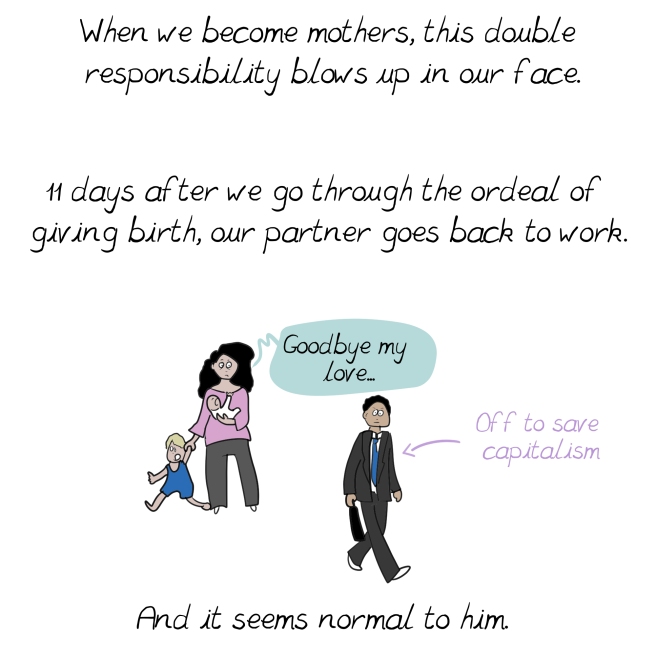
OFF
TO
SAVE
CAPITALISM
LikeLiked by 4 people
This was so wonderful! I’m a divorced single mom of a 19yo son, with a boyfriend who stays with us half the week. I carry the full mental load of making sure all the people end up where they are supposed to be, have what they need, and don’t forget things. I do 95% of the household chores because it’s just easier than asking 20x. My son is also very guilty of taking instructions literally. I leave him to-do items, and if I only write “empty the dishwasher” he won’t refill it with the dirty dishes in the sink. That is my favorite example of this dynamic.
He and I argued about this JUST YESTERDAY when I left a list of things that needed to be done (by both of us) and he assumed it was for me and ADDED ITEMS TO THE BOTTOM OF THE LIST BUT DIDN’T DO ANY OF THEM. He want to do a chore later and asked me if something was ready. I would have had to do the same steps as him to check! “I don’t know, did you look?”
I sent him (and my boyfriend, who isn’t fully responsible for things in the house but will ignore items on the stairs that need to be brought up) this article and he actually said “Ohh. This kind of helped actually.” So thank you!
LikeLiked by 1 person
I also found the article fascinating and had to think quite carefully about how much of the mental load in our house is mine (woman/mother) and how much my partner takes on. I agree with a lot of the previous posts about men often having a mental load that goes un-noticed by their partner and I would agree that in my household the mental load is rather stratified along traditional roles – he is in charge of outdoor stuff and I’m in charge of indoor stuff! I have also come to the realisation that the indoor mental load (which is undeniably greater because it includes all the stuff associated with our kids) is starting to even out a bit more because I just stopped doing stuff that I didn’t feel was essential. The laundry often piles up until no-one has any clean clothes and this prompts someone (not always me!) to go and do some. We run out of milk and cereal and this prompts someone (not always me!) to go out and buy some. Over time, with these crisis points coming more frequently, more partner has started to anticipate them more and the indoor mental load has shifted – now, he “nags” me sometimes!
LikeLike
You might see a woman with an overburdened mental load.
I see a woman with HORRIBLE time-management and organizational skills.
Seriously! Who goes about doing a task (like cleaning off the coffee table), then STOPS in the middle of said task to START a WHOLE NEW TASK?
No wonder it takes you TWO HOURS to clean off a coffee table. You’re NEVER going to get anything done that way!
Clean off the coffee table. THEN do your laundry. THEN put the vegetables away. They won’t rot in the 10-20 minutes it takes you to clean the coffee table and do a load of wash.
Buy a day planner! Download a chore management app on your phone! Structure your day so that you can get important stuff done!
Get. Your. Family. On. A. Chore. Schedule. They aren’t telepathic. What is it with people expecting other people to be telepathic? My mother was like that. I don’t get that.
If the vegetables are on a weekly delivery, get your kids to put away the vegetables on that schedule. A 5-6 year old can pick up towels. They have the upper body strength to be capable of doing that. It’s not like you’re asking your preschool-aged son or daughter to mow the lawn or clean gutters. Create a reward system!
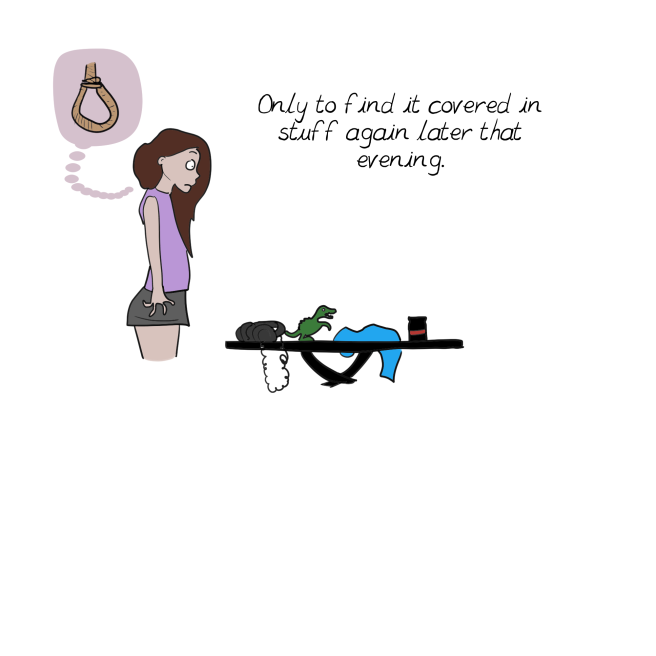
If some stuff remains unfinished, or is undone by the end of the day? What the heck is up with this little thought bubble with the noose? Does a clean coffee table matter more than your very existence?
No matter how much the media wants to convince you otherwise, it’s very difficult to have a Martha Stewart home with children around!
Women don’t have to be EVERYTHING all at once. If you want to work and have a career and have a family and don’t have the energy of a cocaine-fueled hummingbird, you need to accept that sometimes things won’t be clean. Things won’t be put away. Things won’t be done. And that’s OKAY.
That’s LIFE.
LikeLiked by 6 people
That would be one approach, sure. If it works for you, great!
The responsibility still lies with the person writing the list or making (and enforcing) a “chore schedule”, and at some point writing a list comprised of every possible thing that might need to be done (a checkbox for “pick up towel off the floor”?) will be making life more difficult, rather than less. Not only that, trying to rigidly plan ignores that life is messy, and that things get interrupted and forgotten.
From an effectiveness and even an efficiency standpoint, multi-tasking as you move from room to room is often the best way to do a sweep through the house to catch all of those things left over from the rest of the day.
LikeLike
I will tell you who starts one task, then can easily get distracted by another, people with ADD. It doesn’t matter what the age or gender is.
Also you can’t always structure your day because things can happen.
And chore schedules do Not always work. Neither do reward systems, because after a while a child will refuse to do their chores if there is nothing in it for them. And after awhile parents can’t afford the rewards.
LikeLike
I note that you don’t have a single critical thing to say about her partner. Guess the burden DOES fall on women to do everything. Glad to see you emphasizing the author’s point!
LikeLike
“Get your family a chore schedule, they’re not telepathic.” Because you need to be a mind reader to see that a coffee table needs to be cleaned? That vegetables need to be put in the fridge?
Why do you need to be told or reminded? That’s the “mental load” she’s talking about. You see dust on a shelf? Get a cloth and dust it yourself. Don’t wait for the post-it on the fridge that says “dust the shelves”.
LikeLiked by 3 people
I feel you might have missed the point of that comment about the chore schedule: You are advocating that the home is an anarcho-syndicalist commune, and the author and Knitted are viewing it as a small business with employees, while Dana below is decrying the tragedy of the commons. With no clear areas of responsibility, it is always someone else’s problem, and as the author points out, the person who has been trained for management, or the person who is left at home to setup up all the structures is the one who is cast in the role of coordinator.
Knitted is proposing that one should embrace the management role and explicitly delegate. Instead of delegating in the moment when one is overwhelmed, one analogizes to the work world and hire on your employees with explicit responsibilities. With this approach, instead of decrying how the household management is breaking down in general, you can say “We have no dishes to eat off because number 2 son has failed to empty the dishwasher.” In addition, instead of “taking 2 hours to clear the table”, you can focus on emptying the table, because number 4 daughter is in charge of gathering all the clothes and towels from around the house and putting them in the hamper, and number 1 son is responsible for separating whites and colours, getting the washer going, transferring things to the dryer, and number 2 daughter takes care of all the folding and ironing. Number 1 son is really good at separating the whites and colours and not putting woollens in the dryer because he had to go to school with pink socks for a month and hand me down his favourite sweater when it shrunk. The manager in the workplace delegates and forgets. The user of GTD delegates the tasks to themselves in the morning and forgets about them until it is time to do them. The household coordinator can delegate and forget about it until their job is impacted by it not getting done. They can not fire their children, but they can withhold their wages (privileges and optionals) and they can divorce their spouse if the failure to do things amounts to what they consider gross insubordination. Unlike the workplace manager they can subject their children and spouse to redicule and social pressure by blaming them for the the failure to be able to eat dinner on time.
beccalouise points out that the wander around and do things as you see them style is equally valid and takes the same amount of time as making a list of things that need to be done and working through them systematically. Knitted is contesting this point. I am putting words in Knitted’s mouth to say that they are saying it is more efficient and less mentally taxing to employ GTD, but I do not think I am stretching their point to say that they are suggesting it takes less time because you are not doing them. At a minimum all you have to do is make the list of things to do, and other people do them. However, I would extend this to say that all you have to do is identify the areas of responsibility and let the workers identify the tasks in that area, then you don’t even have to take on the mental load of making the list and making sure it gets done each week.
Just to be contrary, I will say that yes you do need to be a mind-reader to see that a coffee table needs to be cleaned. A dining table used daily anyone can see if failing its function when it needs to be cleaned. A coffee table on the other hand has a function of holding random things. The tipping point when it is holding too many random things is a matter of judgement, and that judgement needs to be exercised by the person who is most upset by clutter, by the household coordinator, or by the coffee table clearing expert (the one who has that chore.) Determining the standard of when the table needs to be cleared either needs agreement on that standard or a command-and-control dictation of that standard that can not be achieved without communication or mind-reading. Likewise the dust on the shelf. There is always dust on the shelf. The question is when there is too much dust on the shelf, and whether it is more important to remove the dust on the shelf, keep the children from maiming each other, or have a few minutes of leisure. With the screaming kids and the aching feet who is going to look at the shelf to see the dust on it? If you are seeing the dust on the shelf, and it upsets you, then fix it because it makes you happy to have dust-free shelves, or make it part of the weekly chores to dust the shelves whether they appear dusty to the employee or not. The employee does not need a postit on the fridge that says the shelves have become too dusty and it is now time for them to interupt their routine to do the task for the person that is upset by it. They just do it as part of their regular routine because it is time for the shelves to be dusted.
Knitted is not contesting that it imposes a mental load to tell people in the moment that things need to be done, and to watch it gets done because it is still your responsibility as manager and operator of the home enterprise. Knitted is instead saying that there is a better way, that of modelling hundreds of years of business acumen by instead delegating and taking it off your plate to do it or even track it unless it impacts another part of the organization.
LikeLiked by 1 person
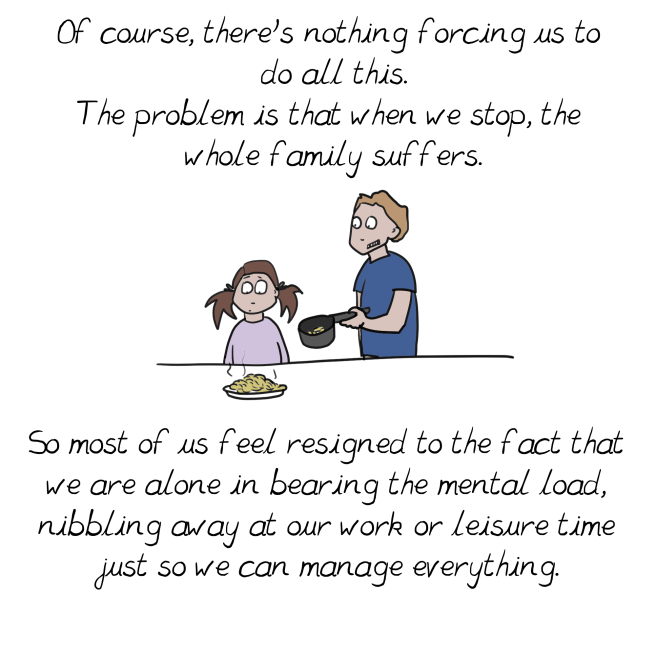
I don’t expect telepathy.. but I do expect a fully grown human being to understand that if there’s something on the floor, pick it up, don’t step over it. If there’s clean dishes in the dishwasher.. put them away. I have two small children and a large puppy to chase after. I don’t need to babysit an adult human male, as well.
LikeLiked by 2 people
2 hours to clear a coffee table or doing it all in a more linear style. Takes the same amount of time to do all those chores which is the point of saying it takes 2 hours to clear a table.
LikeLiked by 2 people
😂 you spent a decent amount of time trying to convince internet strangers that YOUR experience is the correct and only one..
seems like some poor time management skills to me.
LikeLiked by 2 people
Wow. Well, this is how I clean house and I get it all done pretty quickly- but I don’t have kids, virtually no burn out due to working too much (I’m a musician and can pick my jobs) and have a partner who does more than his fair share around the place. But it’s just the way I work. He does his chores more the way you do, one at a time. And then I go along behind him and tidy up the stuff he leaves behind! 😀 Which I don’t mind (though I do grouse about it privately) as I’m fine picking up after my partner because he’s doing things that need to be done and that I can’t do!
Also, it’s not about wanting people to be telepathic. It’s about wanting people to be proactive in taking care of their environment. If you were working a paying job where you didn’t do the work but expected to be paid you’d end up losing that job pretty quickly. Same at home. Why should one person be expected to do “all” the work and then have everyone else in the home not do any one thing more than is asked of them? Empty the dishwasher can be a task, for sure- that’s my partner’s task because I hate it for some reason- and mine is loading the dishwasher. I love doing dishes and I love them to be clean. I’m best in the house at getting the most dishes into the washer and having them come out actually clean- BUT if my partner is busy doing other things I will unload and load the dishwasher without being asked. Or take out the garbage/recycling (as he does, too) and all the rest. When we need a reminder we do our reminding politely and then the reminded one does the task or we renegotiate who does the task.
It’s great to delegate chores but if delegating ends up with more actual work for the person in charge and needing to correct others’ behavior so as to get the desired results (say, clean dishes), it can seem easier in the long run to just do “everything” instead of having to explain a task over and over again to someone who just doesn’t care or isn’t interested in learning to do better.
But I do love your last paragraph- No person needs to do or be everything all at once and a bit of a mess isn’t the end of the world.
LikeLike
I know the examples you used are what got used in the actual comic, but the problem isn’t always a planning one. I’ve had lots of times were there are SEVERAL things at once that needed to be done RIGHT NOW and that’s where everything falls apart. To give you an example of my typical Saturday afternoon, after my parents come home from grocery shopping (usually at between 4 and 6 in the evening) I’m having to haul the groceries in (sometimes with help, but usually my dad has to have a smoke before he gets started and while I COULD wait up for him, if there is frozen stuff that limits the amount of time I can hold off on doing that. On top of that 6 is the time my little brother and the dog gets fed (both of which have a little bit fiddly of diets) and usually I’m having to either get dinner cooked or getting it out of the oven around then too. I DON’T get help putting the groceries away (because apparently I’m better at rearranging stuff and because I’m the one that knows where everything goes. Asking for help here or with the feeding of the kid and dog just ends up with another person in the kitchen getting in my way while I trying to work. If it’s the feeding one then I’m having to deal with people grumbling at me (and since usually I’ve been babysitting for 8 or more hours, I usually don’t want to have to deal with that because it’s emotional wearing) while they do it and if it’s helping, then they’ll pick the easier job (putting away dry goods) and when that’s done I have them walk off because of a “Well, I helped that’s done.” attitude. Or I have to ask multiple times (because someone ‘forgot’ to do it) or I have to take the time to explain what needs to be done even though just looking the person should see several things that COULD be done. It’s not like the schedule changes) On top of that, there usually isn’t enough space for the stuff that got bought anyways (because if one is good, apparently we need six…) and if it was a meat run, then I’m packaging meat too freeze too. And if I didn’t make dinner before they got home (which usually I don’t because there is a three hour period in which they could arrive home and I don’t get told when their arriving until they’re about 10 minutes away from home.) I’m probably having to try and squeeze cooking in there too. There might be a dog walk in there too, my chore under the excuse of “well, I’m tired from all the walking I did” or because even though I asked it gets put off and I’d rather walk the dog then be forced to clean up because the dog has an accident.
It’s not uncommon for them to get home at 5 or 6 and for me not to be done with everything and get a chance to even sit back down until 9 or 10 at night.
The end result is there is a bunch of stuff that need to get dealt with all at around the same time with a similar high urgency, and what little help I can manage to get is usually not worth asking for because it usually takes twice as long, throws my schedule off and results in too much drama just trying to get it in the first place, and I don’t have any control of when it’ll start so I can’t adjust other things (such as feeding the kid and dog) around to make it more efficient.
And even if you’re nitpicking the order in which she did the work in the comic, that doesn’t change the fact that they were still things that would have needed to get done. And it’s not like they were exactly time consuming in and of themselves. But it’s the fact that in order to take care of certain things properly, others have to be done first. For example, sure she could have cleaned all of the coffee table THEN gone on to do the laundry, but both still would have needed doing. The fact that someone brought the vegetables in, but didn’t put them away is still a problem. The fact that it gets dirtied up again later is still a problem.
The thing is, it’s not so much one singular problem. It’s a huge multitude of problems that makes doing things all that much harder and the underlying issue is a lack of both respect and reliability. If you have trouble getting help, can’t rely on it in a timely manner and have to double check that it was done at all (and properly on top of it), then what is the point of even bothering to ask?
LikeLike
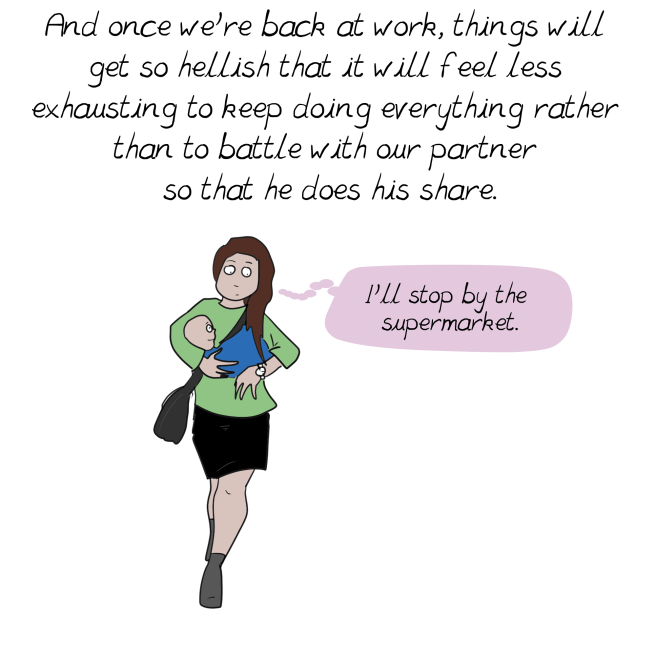
My husband can magically “not see” random messes that pop up. My husband can ignore, “forget” about, or procrastinate on any verbal request or written list I give him. But somehow a chore schedule is going to fix that?
I think you missed the point of this comic.
LikeLiked by 1 person
Wow. So totally missing the point. Such excellent deflection.
“But of COURSE it’s not that she’s doing the organizing AND the work, she’s just not doing it right.”
Absolve yourself. It can’t POSSIBLY be men not willing to figure things that needs done, and then doing them.
/sarcasm
LikeLike
Reblogged this on Darcy Carmela.
LikeLike
While I agree with much of this blog post, I do have a few concerns.
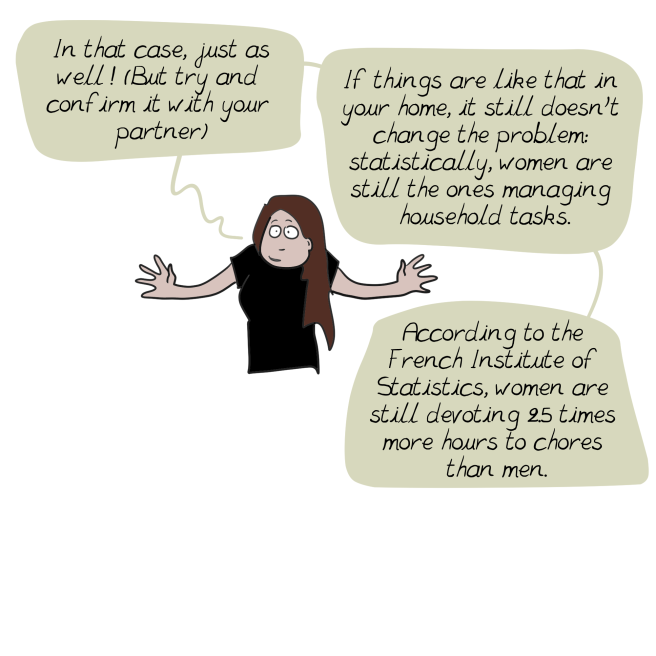
“According to the French Institute of Statistics, women are still devoting 25 times more hours to chores than men.”
Could you cite your source for this? I’m curious to know the demographics and methodology for any surveys they did. Was this only French households? Worldwide? Only wealthy families? Only interviewing women? Without knowing the answers to these questions it is impossible to judge whether this statistic carries any weight.
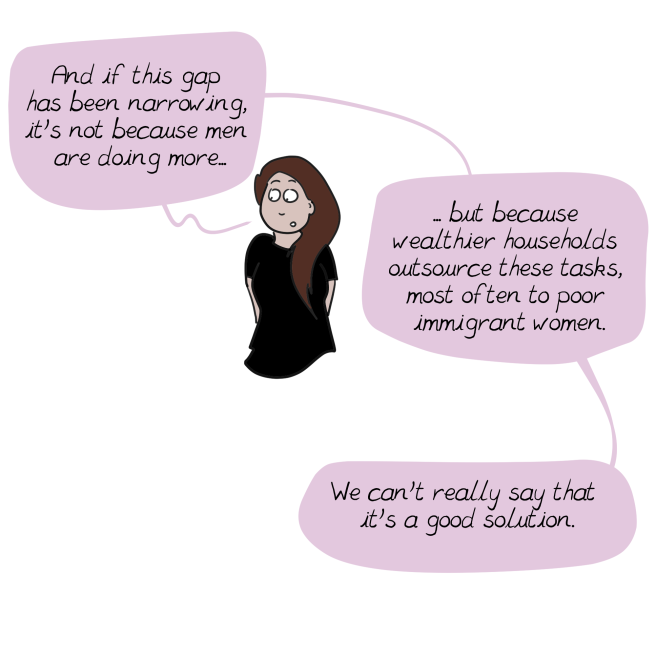
“And if this gap is narrowing, it’s not because men are doing more…”
This is logically incorrect. If the ratio of hours between men and women are shifting, then it must be because men are doing more.
Here’s an example: 25 women do 100% of the work in their household, 1 man does 100% of the work in his household. That’s 25 times as much work by women than men in this sample size. If 5 of those women stop doing the chores because the work was “outsourced to poor immigrant women” that’s still 25 women to 1 man! The only way that ratio drops is if you substitute men for the women. This statistical error leads into my next point.
The tone of the post seems to be, men are bad for doing this, and even if you’re not, you’re wrong. The only opinion that can be trusted is a woman’s opinion. There definitely seem to be some unconscious (or maybe conscious) biases against men here.
Overall, well written and instructive, but loses a lot of impact from bias and lack of sources.
LikeLiked by 2 people
Actually, the ratio can shift without men doing more. If women simply do less, and the men don’t pick up the slack, then less is accomplished in an absolute sense and the ratio shifts.
LikeLike
So what your saying is that suddenly in many households nobody is doing the chores or taking care of the children? People are now living in squalor because the woman in the household is fed up? That’s more believable to you than the idea that men might actually be doing more than in the past?
LikeLike
She cited her source – the French Institute of Statistics. If you want to know the demographics and methodology, and question the value of the statistics, then go to the source and read them yourself. Then if you disagree, you can write and post a researched analysis of why the statistic is flawed, backed with statistics that you support and their citation.
Why should the mental load of doing your research fall to the writer of this article?
LikeLike
When trying to convince somebody of something it is that person’s responsibility to provide evidence. If I try to tell you that the world is flat, it’s my responsibility to give you evidence to support that. I can’t just say, “do your own research!”
Let’s say I find something out there that gives different statistics. I point out where she was wrong. She responds that this wasn’t the study that she was referencing, I need to go find the right one!
Why should the mental load of doing the research fall to the person she’s trying to convince especially when she must know the exact citation already?
I can think of a few reasons not to show a citation in an argument.
1. Laziness.
2. Cherry-picking data.
3. Misinterpreting data.
4. No such study exists.
If she wants to convince me, the burden is on her to give me evidence why she’s right.
LikeLike
2.5 hours – not 25
LikeLike
2.5, not 25. It’s hard to see the dot.
LikeLike
Wow, it’s really hard to see the dot. I had to use my computer to see it. 😊
With or without the decimal, the point is the same.
LikeLike
I believe that number, which appears to be 25 at first glance, is 2.5.
LikeLike
One thing…the reason she says that the gap isn’t narrowing is because instead of the men doing more, the tasks are being outsourced….
I’m not agreeing or disagreeing with anything…just pointing out what the author was saying.
LikeLike
She’s specifically saying it’s being primarily outsourced to women. That would cause the gap to remain the same, not narrower.
LikeLike
The comic describes the work in question as “chores” and “household tasks”. If you are working in somebody else’s home doing that work, that is your job for which you are being paid, and not your household chores, so you would be exempted from statistics measuring such.
LikeLike
@Joseph Liu – I tried to explain this “invisible work” to my ex-husband for 15 years. His responses were: berating me for not appreciating how often he does the dishes; berating me for not being more organized; telling me that I wasn’t doing anything a housekeeper/nanny couldn’t do; trying to convince me that this “invisible work” didn’t actually exist. That last one is particularly insidious.
LikeLiked by 2 people
I remember being on vacation with 3 kids in diapers. We would arrive at our apartment and the air conditioning would hit us like an arctic blast. I needed to get 3 kids bathed and into dry diapers before they made a mess with either sand or pee. I was wearing a full bathing suit – tits freezing. My “beloved” (NOT wrapped in cold wet clothes) sauntered into one of the bathrooms for his own warm shower, every day! We are still married but I will never forgive him. I have learned though, that men are stupid. If you find one with the brains to think about the needs of all the family, clone him. Most need to be told
LikeLiked by 2 people
Love this, but need to say that this isn’t all about gender. My long term partnership with a woman (and kids) absolutely mirrors this. She expected me to track all of the family needs, but didn’t step up unless specifically asked, and would then do only what was asked. I’m all for division of labor, but that’s not what this is.
LikeLiked by 4 people
Sure I think many things can cause this kind of unequal household workload and gender is an important one but obviously not the only one. It is all about feeling responsible of the house or not.
LikeLiked by 1 person
Reblogged this on Beyond Routine.
LikeLike
So great! Thank you! Please would you translate the emotional work load to english too? That would be so great
LikeLiked by 2 people
Yes this will be done but I don’t know when 😉 the French version isn’t even ready !
LikeLike
I will be watching for it too 🙂
LikeLike
Oh yes. Excellent article.
I hadn’t heard anyone refer to “the mental load” before, but it’s a great way to describe all the on-the-fly planning and remembering and synchronizing that isn’t necessarily visible. I swear, the most difficult thing about cooking daily for a family (for example) isn’t the shopping or the cooking or the dishwashing itself (although they might take the most time): it’s keeping straight what we have, what we need, what needs to be used up, what’s available, how much prep it will need and when that could happen, cooking times, which dishes are dirty and which ones will we need, and then, to top it off, some sort of inspiration.
The distinction between “doing” and “taking responsibility for” household tasks is also well made. I think that, above all, is the critical thing to pass along to the next generation. Even if both parents “do” the chores, children will understand intuitively who’s got the responsibility. That informs them not only about gender roles, but also sets them up to take on (or not to take on) responsibility in their own lives.
LikeLike
Thank you. I sent the link to family members.
LikeLike
I have to ask though, Emma, when you see the your colleague struggling to keep up in the kitchen, why didn’t you offer to help?
LikeLike
This touches on another aspect of the original situation that occurred to me:I am still getting a handle on the host-guest relationship even after 15-20 years of being involved in such interactions. I wondered if the husband felt that he was helping by “entertaining” the guest while the social engagement was being organized. I have been in the situation where either I am the host and someone has offered to help, but I have declined because it will mess up my system, or I have offered, and the offer has been declined presumably for the same reason, or for the more nebulous reason of “guests are not supposed to work for their dinner”.
I do not have kids, so my question touches less on that aspect of the situation. ie I might defend the partner for failing to step in and interfere with the dinner preparations, but dealing with the kids interfering with the dinner preparations on the other hand I think it makes a lot of sense to interrupt hosting responsibilities for. As a childless guest, I do not feel it my place to interfere with parenting unless I know the person fairly well and am included in the sphere of the village that raises the child. Without that prior relationship, I would feel far more uncomfortable asking whether they would like to me “deal with” the kids than about whether they would like me to manage some aspect of the meal.
LikeLike
Hmm….sounds quite familiar. I can identify with all of you who said that you’d take it easy. I do that some days when I just don’t want to be tied with “household chores”. Andmore often than not, that’s exactly the day my husband decided to point it to all the imagine things around the house. And mind you, that’s all he does, point out. But yeah, after 20 years of being married to him, I’ve learned to smile through his rantings.
LikeLike
Here’s a great example. I was an inpatient at a mother and baby unit within a psych ward, getting treatment for PND and my husband was visiting me. He asked me “do you think you could call Energex tomorrow to pay the energy bill?” And when I didn’t say anything because I was speechless “oh, and couldyou find out what the interest rate has increased to on our mortgage – or do you know off hand?”. I was stil supposed to be the knower of all things and household project manager, he didn’t even fathom that he could do those things himself. I might also add i work full time and earn double his salary.
LikeLike
Probably right for many families/couples. But don’t forget men have mental loads, too 🙂
LikeLike
Maybe if you actually shared your concerns in a productive and cooperative manner and established common norms instead of just assuming that your partner expects things to operate in the same way you do, just maybe, you wouldn’t end up sounding like someone who wants to be recognized as a martyr. I’ve seen this cycle over and over again, and it typically comes from one partner who has different expectations than the other, but uses hostile language and put downs instead of actually working with their partner.
LikeLike
Reblogged this on Consider That.
LikeLike
Is there a more effective way to have a real solution?
You are still only asking ‘if it wouldn’t be too much trouble’. You are not standing firmly behind the idea that it’s the partner’s responsibility; it’s still just a suggestion, and therefore optional. The problem you are addressing is that the partner is not accepting or even acknowledging anything that can be seen as optional. Since suggestions are already being refused, your solution is not going to have any effect.
LikeLike
Yes. I have wondered exactly why it is so overwhelming to be the home-parent. After many years I realized it was because aside from making the money I do nearly everything else—most challenging is the 24/7 on call emotionally & physically for six other people. There is no break. Ever.
I have stayed up late talking through emotional turmoil with teens & then got up with pre-schoolers having bad nights then got up & got kids out the door, & stressed that one kid is sick, “did I not feed them properly?”
I am 100% sure dad has never concerned himself with kids being sick therefore, he must not have fed them a healthy well balanced diet. Even the best of non-stay-at-home-parents have to admit the do not dedicate a fraction of the mental & emotional energy into the family. That is what the stay at home person does, not just for children but for spouse.
Excellent food for thought & a wonderful exact description of why I HATE clearing off the table.
LikeLike
Reblogged this on E..
LikeLike
Fortunately for myself, my spouse, and our kids, we don’t have too much trouble keeping this issue in check in our household. Many years ago, before we had munchkins, my wife and I talked it out and decided together which one of us was doing to “take point” on the household stuff and which one of us was going to be more career focused.
I like your comic, and I think you for creating it, because as heterosexual dad who voluntarily (and proudly) “stays” home in order to support my wife’s career, I absolutely adore my kids and feel very fortunate for the flexibility that I’ve been offered in my life…but I have to say that it’s VERY hard for me to find male peers with whom I have anything in common.
You’re right on the money when you talk about the way society strictly engenders (pun intended) these roles onto children from the very earliest ages, and this is something I actively combat with my two daughters. They get their share of dolls to take care of and cooking time in their play kitchen, but they also love to play with trucks and trains and when they dress up it’s not always as a fairy princess, sometimes it’s as a doctor or a pilot or a construction worker.
My girls are growing up seeing their mom and dad share the load, and their mom do the majority of the “professional” stuff outside the home, and I’m fine with that. However we know lots and lots of other couples who are either dual earners or include a male homemaker, and I have to say, it’s maddening how much of not only the mental load, but the actual housework, the women in those relationships handle all by themselves.
I know plenty of dudes whose children are 3 or 4 years old, and they can’t possibly take care of them alone for more than a few hours. They can’t shop, plan meals, cook, do laundry or dishes properly, and the house completely goes to shit if their wife has to go on a business trip for a couple of days (and they almost always need “someone to come over” like their own mom or a friend just to survive). Some of these dudes don’t even buy their own clothes! They just transitioned from having a mom, to having a wife. They are still teenagers, in their 30s and 40s.
I don’t know what to say about these guys. I get so mad hanging around with them that I have few friends, I have much more in common with my lesbian neighbors who happen to have two amazing kids the same ages as mine. You’re right that this is a societal problem, and you’re absolutely right that these man-children are being raised wrong from early youth with bizarre ideas about division of labor in relationships…but I also have to ask: what is up with the ladies who partner with them?
Please, my sisters in house-wifery, stand up for yourselves! You and your children deserve so much better than this. Men should be expected to figure this stuff out much more autonomously than they do, you should not have to “nag” them into growing up, and if they’re incapable of that…I dunno, maybe think more highly of yourselves when selecting mates?
Some of these guys simply aren’t husband or dad material. I don’t get why smart, driven, accomplished ladies end up with these fellas. I don’t know how to fix this issue for other people, but I can tell you this, I sure as hell am raising my daughters to expect a lot more.
LikeLiked by 6 people
It’s wonderful that you’re raising your daughters in a truly equal home. I wish more were raised this way. I know many women who had better paid jobs than their spouses but were still the ones who were expected to stay home (and of course the current UK maternity / paternity leave situation doesn’t help this).
I’ve encountered some truly deadbeat dads in my time but this problem goes beyond that, men who are otherwise excellent parents and spouses behave this way too. I hadn’t realised this affected so many others until I found this comic shared in a group I belong to, and saw the responses. My husband is a wonderful partner and father, but he is definitely guilty of waiting for me to ask for help rather than being proactive and he constantly wonders why I am so stressed.
For me it’s not just the physical workload but the mental workload I find exhausting and stressful. It’s not just the stress of juggling 100 things at once, but being the one who makes all the decisions also means you feel responsible if you make the wrong one, or forget something because you’re so overloaded. I’m building up to showing this to him because I really want him to understand why I am struggling despite his “helping out”.
LikeLike
Come on guys, take some responsibility. Do not feel attacked. This is a societal problem that all of us, men and women, can do something about. See it as an opportunity. And yes not all situations are like this, but enough of them are that this should resonate with all of us.
LikeLiked by 3 people
* Why does the woman get to determine how clean the house should be, and what the standards of care need to be?
* If a man says, “I am open to having a child with you, but only if you take care of most of the child care,” would you feel wronged?
LikeLike
LOL, this is what you get when armchair psychology meets armchair feminism.
One of the flaws here is that this is premised on households consisting of a man and woman in a relationship, without regard to any kind of control group. Ask anyone who has lived in any household with any kind of roommates, especially those that are all of the same gender, whether the division of responsibilities/chores or mental/emotional tasks is equitable. This dynamic has even been a mainstay of popular sitcoms for generations.
Frequently there will be one member of the household who more or less takes on the brunt of this role as described in the article. Why one person assumes this responsibility while others abdicate it can be a complex dynamic. Often that same person will take on this responsibility in multiple households over the years, though in other cases they may relinquish that to someone who is more dominant in the role. It can actually be quite a point of contention if two people try to assume this role at the same time. What this article portrays as labor or victimization may also be seen as a higher ranking status, control, domination or privilege by others. Being in charge is a double-edged sword.
Further, the management of stress, planning, prioritizing and time (to name a few) are handled (or mishandled) quite differently by different people. While having a pity party may provide some degree of solace, it might be more prudent to acknowledge your own skills in the aforementioned areas and address those that you feel are problematic through professional or self-help. Expecting your spouse, partner or roommate to share in becoming a stressed-out basket case in order to alleviate your own psychological or emotional challenges of coping with the responsibilities of adulthood is probably not very realistic. This is not to say that reallocating household responsibilities is an unreasonable course of action, however it’s primarily your own responsibility to manage how you handle stress. If you don’t address that, it’s just going to creep up again in other areas.
LikeLike
When she’s looking at the messy table, is she thinking of a noose??
What else did she mean by “take the bottle out of the dishwasher” other than what it literally means?
My mom and my (male) partner always do this mental list work and a lot of cleaning and I tell both of them that they are doing things that don’t matter, that no one else cares about. Just let things be messy for a while.
LikeLike
If one member of the couple (whatever the sex or gender) takes the role of the manager (usually the woman but I have seen it both ways) then the other knows they are going to be nagged or yelled at if they don’t do the job as they were supposed to do it (one has to guess).
With time, the person assumes the subordinate role (after painfully learning that there’s no way to please the other person), and thus they don’t do anything until they ask, and then just do it as it was told.
LikeLike
Spot on Emma!
LikeLike
As a divorced guy who is now fully in charge of my own household, since it’s just me and my kids (joint custody), I’ve gained a new appreciation for the “mental load”. I’m constantly thinking about all the tedious, menial, miserable household tasks that need to get done. On the other hand, I’ve also realized the world doesn’t come to an end if there is a little clutter on the table for a few days or the dishes sit in the sink overnight. Or the laundry is piling up. I’m perfectly comfortable having a slightly cluttered, untidy place. Instead of having to deal with someone else’s unnecessarily rigid cleaning standards imposed on me, e.g. an empty used cup should be immediately tended to, or if the garbage is full it must be immediately emptied.
LikeLike
I think some of the problem is division of labor and perception of what is important. I got married in my 40’s and already had a career than demands more time than my wife did. I take care of traditional “man” things such as the investments, the taxes, the yard, most repairs, the garbage, the recycling. I do my own shopping&cooking, clean my own clothes, and clean my own mess. I contribute time and effort to taking care of our child (and her messes) and pay for our weekly house cleaning. However, my wife contributes more time and effort taking care of our child and often cleans up the house. I know she resents this. Beyond that, I don’t know what to do or say.
LikeLike
Another issue is values. I find that my wife’s (unstated) list of what needs to be done is more extensive than mine. I’m OK if the house is more messy, if we don’t get a dog (which is a lot of work btw), if we don’t buy more stuff that clutters the house. I’d prefer to spend more time “Carpe-ing the Diem” (playing with our kid, exercising for example) and having a slightly sloppier and more Spartan life style.
LikeLike
Thank you for the translation from french, I can now share it with my wife !
I can totally relate to this except that I am a dude and that the situation discribed here is reversed in my couple. We don’t have kids yet and I refuse this to happen before the balance of mental load gets better (if ever).
Witnessing the traditional situation where the mom bears 99% of the mental AND physical load in my parents’ household, I’ve always promised to myself that I would do my half of the duties when in couple. Far from thinking that I would actually end up “being the wife”.
My wife comes from a family and culture where she would mostly be focused on her studies and have both her parents take care of all the rest. She became someone very strong in focusing on her carreer and on gaining new skills that will make herself even more gifted intellectually and socialy. In this context, household work is not considered useful, and she’d rather priorities resting from work than participating actively in the weekly cleaning work.
I do agree people most often reproduce the patterns they’ve seen in their families. I don’t know what happened in our situation but it got reversed in a slowly unbearable situation.
When arguing, her arguments is usually that we have different standards of what’s tidy and clean and some things one sees as important may be secondary to the other. Which I can understand, but in fact she doesn’t even take care of administrative papers, bills to pay on time, taxes, managing bank accounts and the appartment we bought and so on.
I end up giving up on sharing the work and prefer to do it by myself rather than asking, to avoid getting angry and fighting. I know it is just a short term solution because I build up frustration and become less lovung and less patient…
What would you answer when you get told that it is your own choice to burden your mind with a list of not so useful invisible works ?
LikeLike
Reblogged this on descantdeb and commented:
An empathic breakdown without talking down….
LikeLike